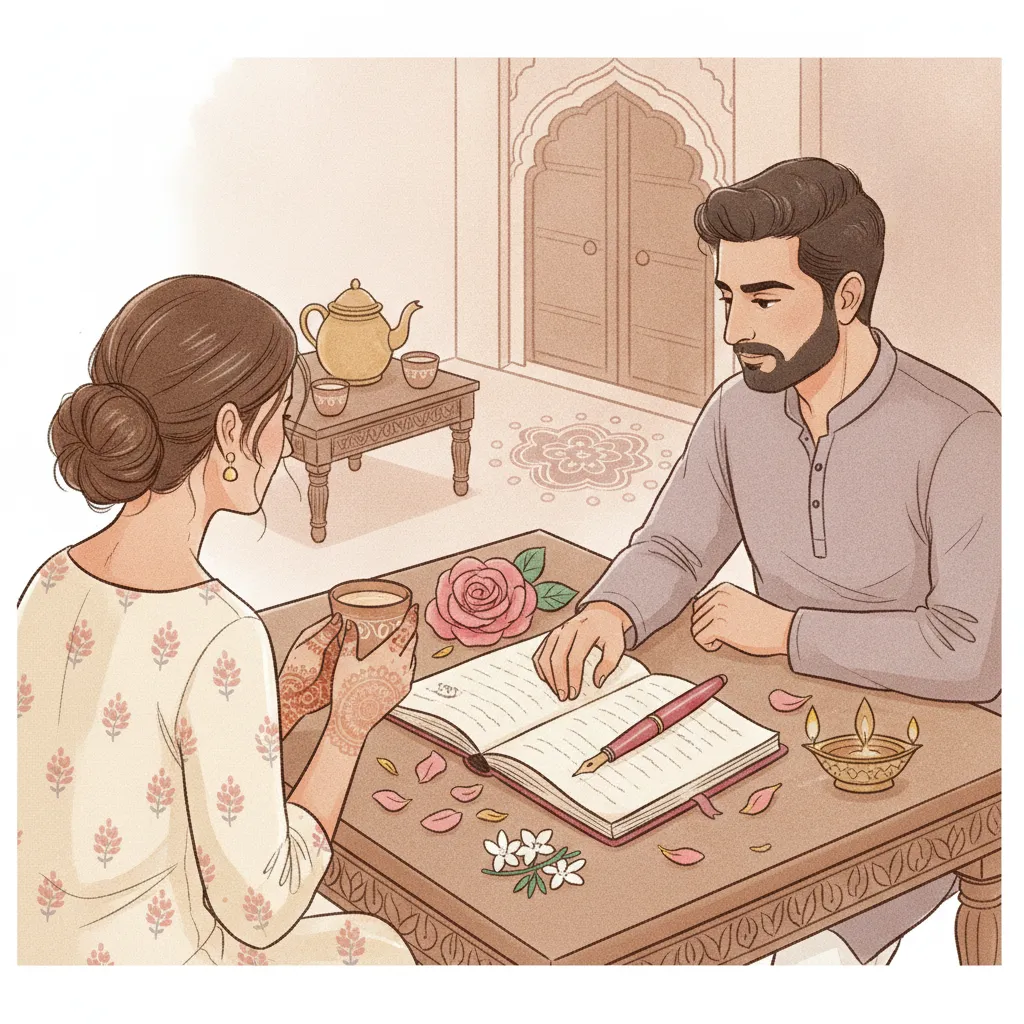
Imagine a couple, seven years married. They are sitting on their modest balcony in Indore on a Tuesday evening, discussing a difficult decision: his mother’s health is declining and she needs more care. The conversation is not loud, not dramatic. It is quiet, weighted, and full of long pauses. He is worried about the cost and the emotional toll. She is thinking about the logistics, how it will change their daughter’s routine. They do not agree instantly. He feels a surge of filial duty; she feels a protective pull towards the life they have built. But underneath the disagreement is a vast, calm reservoir of trust. They know, without question, that they are on the same team. The goal is not to win the argument, but to find the best path for the family they have become.
This quiet, resilient partnership is not a stroke of luck. It is the direct result of a choice made seven years ago, a choice that valued readiness over timeliness, and substance over speed. It is a future available to you, but it requires resisting one of the most powerful forces in the Indian matrimonial search: the birthday that turns into a deadline.
The Weight of a Number
For many, the shift happens around the twenty-seventh birthday. The gentle "So, any thoughts on settling down?" that you heard at 24 from a well-meaning auntie at a wedding hardens. At 27, it becomes a direct question in the family WhatsApp group. By 28, it has the weight of an impending crisis. Every conversation with a potential match feels heavier, freighted with an unspoken question: "Can we finalise this, quickly?"
This pressure is not imaginary, and dismissing it is a mistake. Your family is not trying to make you unhappy. They are operating from a script written across generations, one that holds a few core anxieties. It’s more than just “what people will say.” It’s the fear of a biological clock, a genuine anxiety that gives the deadline its power. It’s the concern about diminishing financial or social security in a world that is still structured around couples. And it's the deeply felt desire to see you embark on the next phase of adult life, a phase they equate with stability and completion.
Acknowledging the love inside their fear is the first step. The second is recognising how that external clock starts to mess with your internal one. The deadline makes you lie to yourself. You start to mistake your own impatience for their readiness. A decent first meeting feels like a soulmate connection. A few shared interests feel like a foundation for life. You begin to see what you want to see, filtering their words and actions through the lens of your own urgent timeline. Their anxiety about closing a search becomes your anxiety. But your task is to open a life. These are not the same goal, and confusing them is the most common, and most costly, mistake a person can make at this stage. The calendar tells you what year it is. It tells you nothing about a person’s ability to build a marriage like the one on that balcony in Indore.
When Urgency Becomes a Tool
The pressure of a deadline changes behaviour—yours, and that of the people you meet. For a person who is genuinely ready, the timeline is a logistical detail. For someone who is not, or for someone with an extractive agenda, the timeline becomes a tool. It becomes a reason to bypass difficult conversations, to accept vague answers, and to mistake a smooth presentation for a solid character.
Consider Rohan, a 29-year-old from Jaipur working in a high-pressure sales job. He meets Anjali, a 28-year-old physiotherapist. On their third meeting, he says, "My parents are really hoping we can give them an answer before Diwali. You know how it is."
This is a calibrated move. The surface is all politeness and shared cultural understanding. But look at what it accomplishes. It reframes the decision not as a mutual one between Rohan and Anjali, but as a task they need to complete for his parents. It introduces a deadline that is not theirs and makes Anjali responsible for meeting it. It probes for compliance: Is she someone who will yield to external pressure? Does she prioritise the comfort of his family over her own need for clarity? While this dynamic is shown here with a man setting the pace, it runs just as often in the other direction—the core mechanism is about using a clock to rush a choice, and that has no gender.
The innocent version of this is a person genuinely caught in a pressure cooker, who presents it as a shared problem: "My family is pushing for a timeline, which feels fast to me. How do we want to handle these questions together?" The tone is collaborative. It invites an alliance against the pressure. Rohan’s version, however, applies the pressure directly.
The right counter is not a confrontation, but a simple statement of fact. "I get that everyone's excited, but for me, this isn't something that can be rushed. Getting it right is what matters."
This response does two things. It validates his family's feelings without accepting their deadline. And it tells him, clearly, that you cannot be rushed. His reaction to this boundary is more telling than anything he said in the first three meetings. Does he respect it? Or does he double down, perhaps framing your caution as "overthinking" or a lack of seriousness? The First Memory Rule: Trust Patterns, Not Promises, because this small moment is the first data point in a very long story.
Gauging Readiness: The Evidence You Can Actually Gather
A birthday is not evidence of maturity. Readiness is. But readiness is an internal state, invisible to the eye. What you can see is the behaviour that flows from it, so instead of asking "Are they old enough?", you must start gathering evidence around the real questions of character. This isn't about setting up tests, but about paying attention to the unscripted moments that reveal a person’s inner architecture. You can start by listening for how they speak not of a triumph, but of a failure—a business venture that failed, an exam they didn't clear, a friendship that ended badly. Is the story a catalogue of external blame, full of bad luck and difficult people? Or do they take ownership of their role in it? A person who cannot own their past mistakes is structurally incapable of repairing future ones. From there, you look at the gap between their words and their wallet. Many people will talk about a future of travel and ambitious projects. The real evidence isn't the dream, but the mechanics. A person whose ₹50,000 monthly spending is consistently misaligned with their stated goal of saving for a down payment is not just bad with money; they are uncomfortable with reality, a discomfort that will ripple through every major decision you make. This discomfort often reveals itself most clearly in small, recurring frustrations. Forget the one-off drama of a flat tyre; watch how they handle the grinding annoyance of their two-hour daily commute on the Mumbai local. After a month, is it still a source of constant, bitter complaint, or have they adapted, finding ways to make the time useful or at least tolerable? A marriage is a long series of managed irritants, and their approach to a mundane one is a preview of their resilience. Finally, look for who they are when they are tired. We all present our best selves in the first few meetings, but the real person emerges at the end of a long, frustrating workday. Do they become curt and demanding? Or do they simply become a quieter version of themselves? You are not marrying the person who shows up for a planned Saturday coffee; you are marrying the person who comes home on a draining Wednesday night.
The Agreeable Match and the Two-Meeting Difference
Sometimes, a person's response to the deadline isn't to rush you, but to offer a frictionless, almost unnerving agreeability.
Karthik, a 28-year-old civil services aspirant in Patna, met Priya, a 26-year-old schoolteacher. Their first meeting was wonderful. She seemed to share all his core values. She liked the same books, had a similar vision for the future, and deferred to his opinion on where they should live. He left feeling he had found an incredibly compatible partner.
The second meeting was a family lunch. His sister asked Priya about her passion for teaching. Priya gave a polite, standard answer. Later, his father asked about her views on managing finances in a joint family. Again, her answer was perfectly reasonable, but it mirrored what Karthik had told her about his family’s views last week. By the end of the lunch, Karthik felt a strange sense of unease. He realised he knew all of Priya’s positions, but he had no idea what Priya thought. She wasn't a person; she was a reflection.
This is the two-meeting difference. In the first meeting, agreeability feels like compatibility. In the second, surrounded by the complexities of family, it reveals itself as a strategy. The strategy is to become whatever the other person wants, to present a problem-free profile to close the search quickly. This person is not necessarily malicious. Often, they have been taught that being agreeable is their primary value. But a partnership built on a void cannot stand. The first time a real disagreement is necessary, the entire foundation will crumble. Why a "Problem-Free" Match Is the Biggest Problem of All is that it leaves you with no tools for repair when the first real problem arrives.
A gentle way to probe this is to present a low-stakes dilemma and simply observe their response. Over their next chai, Karthik might say:
"I'm in a bit of a bind. My cousin’s wedding is in Delhi next month, but it’s the same week as a major test series. My parents think I should just go for the day, but I’m worried it’ll break my study rhythm. It feels like a no-win situation."
He is not asking for her permission or a direct solution. He is sharing a problem and watching for her thinking. Does she engage with the dilemma? Does she ask questions, weigh the priorities, or offer a perspective—even one that challenges his own? Or does she default to a safe, pleasing answer like, "You should probably do what your parents say"? A partner is a thinking ally, not an echo. If their only function is to agree with you, you are better off alone.
The Conversation You Can Have in Year Five
Let’s go back to that couple on the balcony. The reason they can navigate the conversation about his mother’s health is because of the hundreds of smaller, less consequential disagreements they learned to handle in years one, two, and three.
Choosing a partner under the gun of a birthday deadline short-circuits this essential training. It prioritises a "yes" over a "how." You find someone who agrees to the marriage, but you never find out how they disagree, how they handle stress, how they recover from a mistake, or how they ask for help.
When you resist the deadline, you are not being difficult or slow. You are buying time for the truth to emerge. You are creating the space to see the person, not just their profile. You are choosing to build your future on the bedrock of character, not the shifting sands of a calendar. This choice might make you unpopular at a few family gatherings now, but it is the choice that earns you that quiet, resilient, unbreakable partnership on a Tuesday evening, seven, fifteen, and thirty years from now. That is a deadline worth meeting.