Listen — audio overview
In the intricate journey of finding a life partner within the Indian matrimonial landscape, you are often navigating a complex web of personal desires, family expectations, and societal norms. It’s easy to feel overwhelmed, to lose sight of what truly matters to you amidst the fast timelines and myriad considerations. After reading this article, you will possess a clearer method for identifying your fundamental, non-negotiable personal values. You will be better equipped to distinguish these from the external expectations that often masquerade as your own desires, empowering you to make more authentic, fulfilling choices in your search for a life partner.
Surfacing Your Five Core Values: A Reflective Exercise
Your core values are the deeply held beliefs and principles that guide your decisions, shape your perspective, and fundamentally define who you are. They are the compass for your life, indicating what you prioritise, what you stand for, and what brings you true satisfaction. Unlike fleeting preferences or external pressures, core values are intrinsic, stable anchors. Before you can assess a potential life partner against these values, you must first articulate them for yourself.
Here's a simple, yet powerful, exercise to help you surface your top five core values:
Step 1: Reflect on Moments of Deep Satisfaction and Frustration
Take some quiet time, perhaps an hour, with a pen and paper or a digital document. Think back to specific moments in your life – both personal and professional – where you felt profoundly satisfied, genuinely happy, or deeply proud. What was happening? What aspect of the situation resonated with you? Similarly, recall moments where you felt frustrated, angry, disheartened, or deeply uncomfortable. What specifically triggered those feelings? What principle felt violated?
- Example: Imagine a 30-year-old software engineer from Hyderabad. He recalls a moment of deep satisfaction: spending his Diwali bonus to set up a small library in his ancestral village, seeing the children’s excitement. He also remembers a moment of frustration: a colleague taking credit for his innovative project at work, leading to a profound sense of injustice.
- Initial thought on satisfaction: Helping others, knowledge, community.
- Initial thought on frustration: Integrity, fairness, recognition for hard work.
Step 2: Identify the Underlying Principles
Now, look at the situations you listed. For each moment of satisfaction, ask yourself: "What underlying principle or belief was being honoured here?" For each moment of frustration, ask: "What core belief was being violated or ignored?" Write down single words or short phrases that capture these underlying principles. Don't censor yourself; just list everything that comes to mind.
- Continuing the example:
- From the library: Service, education, community upliftment, legacy, accessibility.
- From the work incident: Honesty, accountability, respect, justice, meritocracy, transparency.
Step 3: Group and Consolidate Your List
You'll likely have a long list of words and phrases. Now, group similar concepts together. For instance, "honesty," "integrity," and "truthfulness" might all fall under a broader value like "Integrity." "Helping others," "compassion," and "empathy" might become "Service" or "Generosity." Look for patterns and overarching themes.
- Continuing the example:
- "Service," "community upliftment," "helping others," "generosity" could consolidate to Contribution.
- "Education," "knowledge," "learning" could become Growth.
- "Honesty," "accountability," "integrity," "justice," "fairness" could consolidate to Integrity.
- "Respect," "transparency" could be linked to Respect.
- "Meritocracy," "recognition for hard work" might imply Achievement.
Step 4: Prioritise Your Top Five
From your consolidated list, pick the five values that resonate most deeply with you. These are the values that, if consistently upheld, make you feel most alive, authentic, and purposeful. These are the principles you would be unwilling to compromise on in a significant life decision, especially choosing a life partner. Rank them in order of importance.
- Final top 5 for our engineer (example):
- Integrity
- Contribution
- Growth
- Respect
- Autonomy (perhaps discovered during consolidation as he values making his own choices without undue pressure)
This exercise provides a personal rubric. When you meet potential partners, or even just discuss them with your family, you can mentally (or even explicitly) assess how well their expressed priorities and past actions align with your five core values.
Navigating Cultural Influences: Society's Desires vs. Your Own
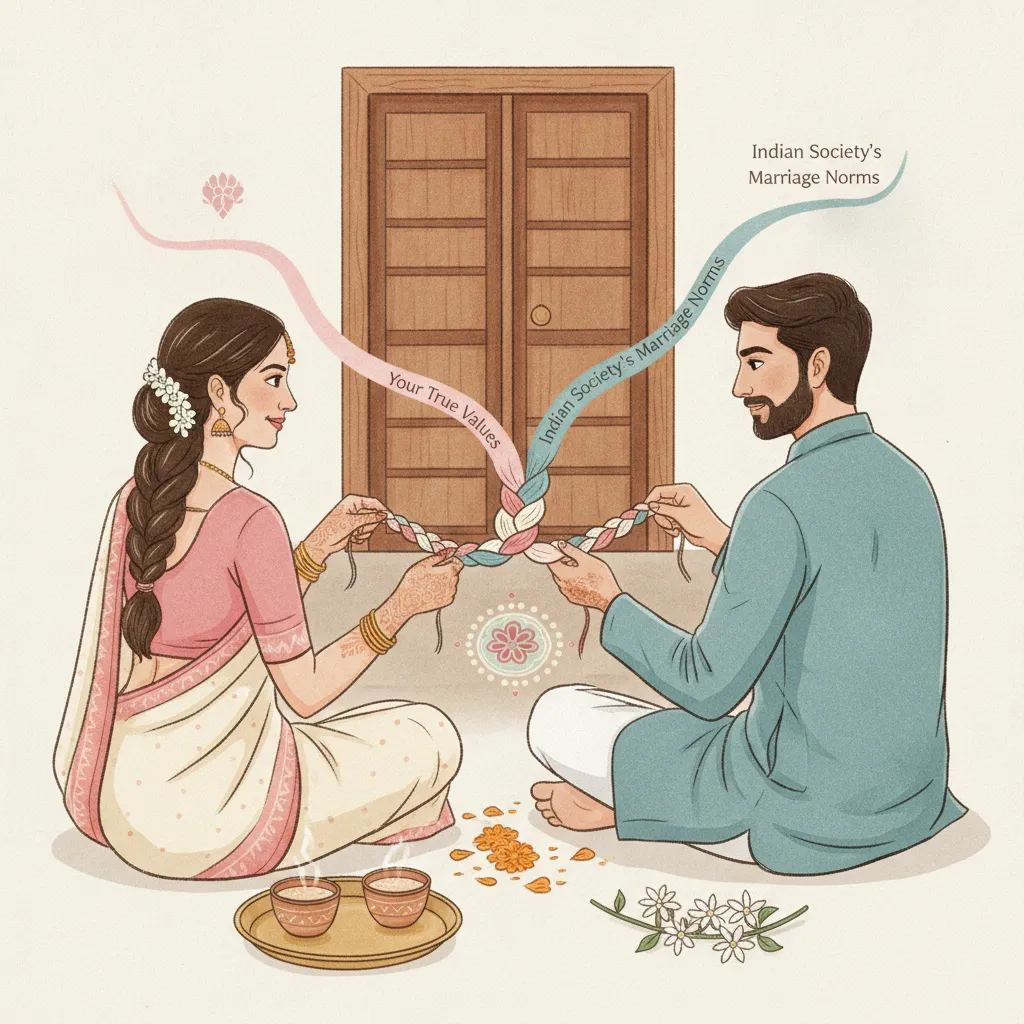
Indian matrimonial searches are inherently communal. While this offers a valuable support system, it also means that societal and familial expectations often intertwine with, and sometimes overshadow, individual desires. It's crucial to distinguish between a "good match" in the eyes of society and a "good match" for you, based on your core values.
Several common cultural considerations frequently get conflated with personal values:
- Status and Prestige: This often manifests as pressure regarding a partner's profession (e.g., doctor, engineer, IAS officer), their family's social standing, wealth, or even the type of property they own (e.g., an independent house in a prime locality vs. an apartment). While a secure lifestyle is a valid preference, for many, the primary drive behind seeking "high status" is external validation or fear of social judgment, rather than a personal value like "financial stability" or "intellectual partnership." Your family might value "being seen well by relatives" more than you value "personal fulfillment in career."
- Caste and Sub-Caste Alignment: Despite evolving attitudes, caste remains a significant factor for many families, often prioritised over individual compatibility. The emphasis on matching specific caste or sub-caste affiliations is largely a matter of preserving tradition, lineage, and social network homogeneity. While cultural background can contribute to shared understanding, reducing a partner's worth to their caste rather than their character or values is a societal dictate, not an intrinsic personal value. For you, "shared cultural background" might be a value, but "same caste" is a specific manifestation, not the value itself.
- Dowry/Stridhan Expectations: Though illegal, the practice of dowry, or implicit expectations around gifts (often termed 'stridhan' to reframe it), still surfaces in various forms. Families may push for a partner whose family can provide significant gifts or assets, framing it as "security" or "status." This is a transactional expectation rooted in traditional power dynamics and economic considerations, not a personal value like "financial responsibility" or "mutual support." If you value "financial independence" or "equality," accepting or demanding such arrangements fundamentally clashes with your own tenets.
- Joint Family Living: The preference for a partner who will seamlessly integrate into, or thrive within, a joint family structure is a common expectation, especially for women. While the value of "family connection" or "community" is deeply ingrained in Indian culture, the specific mandate of living in a joint family might be a family expectation rather than your personal value. Your core value might be "family closeness," but your personal preference for achieving that might be different – perhaps frequent visits, rather than cohabitation. If your value is "autonomy" or "privacy," a forced joint family setup could lead to significant internal conflict.
The Nuance: Recognising the Difference
The key is to ask: Why is this important to me? Is it because it genuinely aligns with my personal sense of purpose, growth, and happiness? Or is it because I fear disappointing my parents, or being judged by my aunties and uncles?
- Example Scenario: Imagine a 28-year-old woman in Bengaluru whose parents are strongly advocating for a match from a specific high-status caste, primarily because "it will look good" within their social circle and ensure their daughter lives in "comfort."
- Societal Expectation: Match from X caste, good family reputation.
- Her Personal Values (from her exercise): Intellectual partnership, mutual respect, shared ambition, autonomy, financial responsibility.
- The Conflict: While "comfort" might align with "financial responsibility," if the potential partner's intellectual capabilities are average, or he lacks respect for her career aspirations, her core values of "intellectual partnership," "mutual respect," and "shared ambition" are directly challenged. The caste factor, an external demand, is eclipsing her internal compass. She needs to recognise that while her parents' intentions might be loving, their criteria for a "good match" may not be hers.
Recognising these cultural expectations for what they are – external pressures – allows you to hold them at a distance while focusing on your authentic self. It’s not about rejecting tradition outright, but about ensuring that your personal compass guides your most important life decision.
The Long-Term Cost: Why Mismatched Core Values Predict Resentment
Marrying someone whose core values are significantly different from your own is like trying to navigate life with two different maps. You might start at the same point, but you'll constantly be pulling in different directions, leading to friction, misunderstanding, and, ultimately, deep-seated resentment. Core values aren't about superficial preferences; they dictate how you approach fundamental aspects of life.
Consider how values manifest in daily life:
- Financial Decisions: If one partner values "security and saving" above all, and the other values "experiential growth and spontaneous spending," their approach to managing household finances, planning for the future, or even taking vacations will be a constant source of tension.
- Parenting Styles: A parent who deeply values "discipline and tradition" will clash with one who prioritises "individual expression and freedom" in raising children. These aren't just personality differences; they stem from divergent core beliefs about what makes a good human and a happy family.
- Life Goals and Priorities: If your highest value is "social contribution and community service," but your partner's is "career advancement and personal comfort," your energy and resources will naturally flow in different directions, leading to a feeling of being unsupported or misunderstood. One partner might feel the other is selfish, while the other might feel constrained.
- Conflict Resolution: Someone who values "direct communication and honesty" will struggle with a partner who prioritises "maintaining harmony and avoiding confrontation," even if it means sweeping issues under the rug.
When your deepest values are not aligned with your partner’s, you consistently find yourself making compromises that chip away at your authentic self. Over time, these small concessions accumulate, leading to a sense of being unheard, undervalued, and unfulfilled. This isn't just "unhappiness"; it's a profound sense of injustice or betrayal towards oneself, which festers into resentment. You start to view your partner not as an ally, but as an obstacle to your own well-being and growth.
This resentment erodes the very foundation of a relationship: trust, intimacy, and mutual respect. You may grow apart, living parallel lives, or find yourselves in endless, cyclical arguments that never get resolved because the underlying value conflict is never addressed.
Patterns to Recognise
During your matrimonial interactions, be vigilant for these indicators that might signal a fundamental value mismatch:
- Frequent Discomfort with Their Priorities: You often feel a pang of unease or disagreement when they express what’s most important to them – be it their career, family obligations, social life, or financial goals.
- Recurring, Unresolved Arguments about Core Choices: You find yourselves circling back to the same arguments about how money should be spent, how family time should be allocated, or what constitutes "success," without ever reaching a satisfying consensus.
- Feeling Obligated to Compromise on Significant Matters: You consistently feel that you are the one sacrificing what is deeply important to you, while their core needs seem to be met more frequently. This isn't about give-and-take in daily life, but about fundamental life direction.
- Lack of Shared Vision for the Future: When you imagine your life 5, 10, or 20 years down the line – your lifestyle, your social impact, your personal growth – their vision seems starkly different, and you struggle to see how your paths would meaningfully converge.
- Excuses for Their Behaviour or Beliefs: You find yourself internally (or even externally) making excuses for why their actions or stated beliefs don't quite sit right with you, rather than acknowledging a deeper misalignment.
What to actually do this week:
Take out your list of 5 core values. Before your next arranged-match meeting or family discussion about a potential partner, review them. During the conversation, actively listen for cues and ask questions that would reveal the other person's values. For instance, instead of asking "Do you like joint families?" (which invites a socially acceptable answer), try "What does 'family' mean to you? What role does community play in your ideal life?" Or, instead of "What do you do for work?", ask "What drives you in your career? What gives you a sense of purpose?" Compare their answers not just to your preferences, but to your core values.
Choosing a life partner is perhaps the most significant decision you will make. By dedicating the time to understand your true values and having the courage to align your choices with them, you lay the foundation for a partnership built on mutual understanding, respect, and enduring contentment, rather than the slow burn of regret.