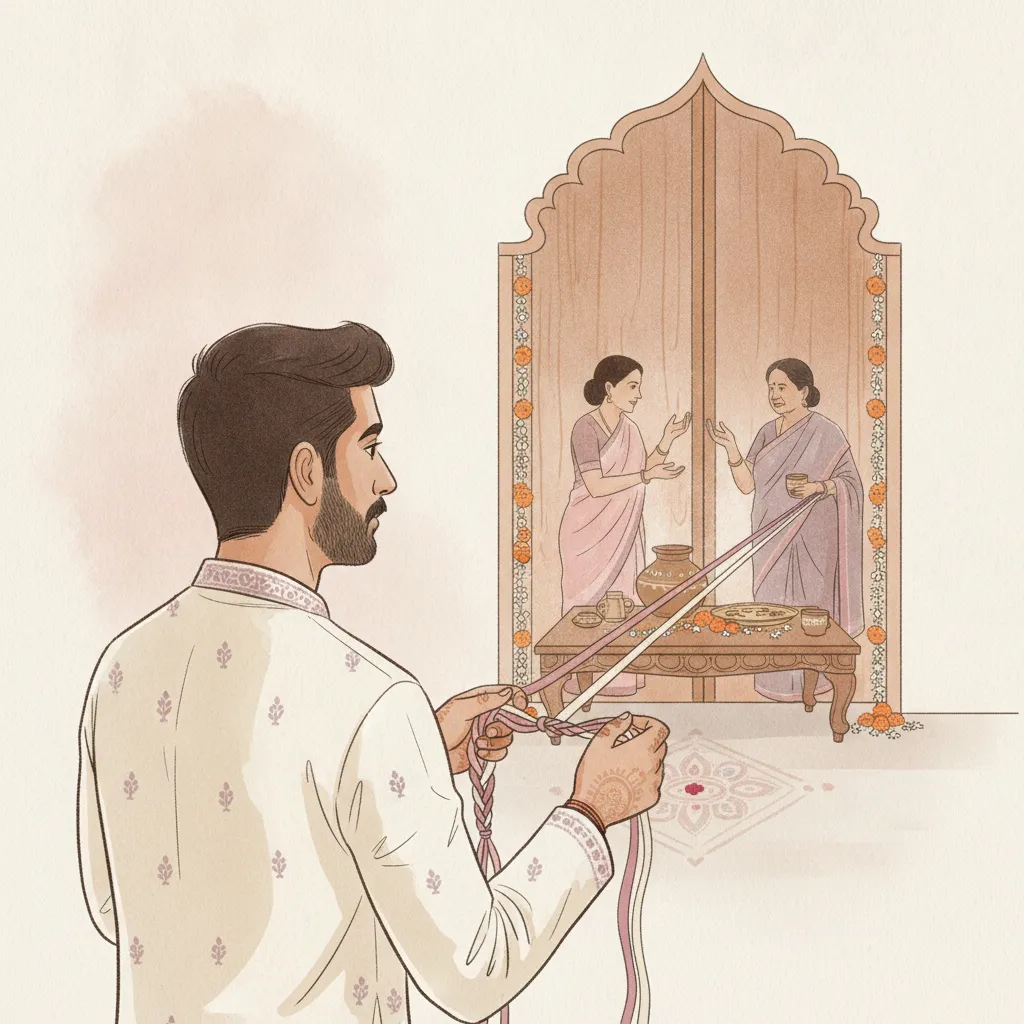
The most important thing you can learn in this process is to distinguish between the urgency of enthusiasm and the urgency of strategy. One is a sign of a hopeful beginning. The other is a tool to prevent you from looking too closely.
The Anatomy of Urgency
When pressure to finalise a wedding date arrives early—before you’ve even figured out how they take their coffee or whether they argue with their mother—it is doing a job. It’s not just about excitement. It’s a social mechanism that changes the physics of the entire conversation.
Consider a common scenario. You’ve met someone three times. The conversations are pleasant. You’re hopeful, but you are still very much in the discovery phase. Then, you hear this: “My parents have already mentioned to our close family in Jaipur that we’ll likely be getting married in December.”
Let’s decode what is happening here. This isn't just a simple update. It's a calibrated move.
The immediate effect is to create social momentum. A private "no" from you is now reframed as a public rejection that will cause their family to lose face. The decision is no longer just about two people assessing compatibility; it's about upholding a social announcement you never agreed to. The burden of proof has been quietly shifted. Before, they needed to convince you to say yes. Now, you need a compelling, defensible reason to slow down or say no.
This move is also a probe. It's a low-stakes way of finding out how you respond to social pressure, especially when it comes from their family. Do you absorb it without question? Do you prioritise their family’s comfort over your own need for clarity? A compliant response teaches them that social obligation is an effective lever. Swap the genders in that scene and its function remains exactly the same—this is about a dynamic, not a personality type.
Now, this doesn't automatically signal bad faith. The incentive could be entirely innocent. It might be a genuinely excited family that operates on traditional, faster timelines. It could be social awkwardness or a simple misreading of your own readiness. An honest person, driven by enthusiasm, might genuinely believe this is just sharing good news.
But the extractive incentive is also real. The goal can be to lock you in before you discover the undisclosed debt, the history of failed business ventures, the expectation that your salary will support their family, or the degree to which a parent’s opinion dictates their every decision. Speed is the best friend of a curated image.
The innocent version of this behaviour sounds fundamentally different. It absorbs pressure instead of applying it. It sounds like: “My mother is so excited, she’s already asking if she can tell her sister. I’ve told her we need to wait until we are both completely sure. The last thing I want is for either of us to feel any pressure.”
The difference is clear: one person makes their family’s expectations your problem. The other makes your comfort their priority.
Speed as a Shield
A rushed timeline doesn't just accelerate a decision; it acts as a shield, preventing discovery. Nikhil seemed perfect. He was a consultant from Bangalore, charming, and after four meetings with Anjali, he was pushing hard for a wedding within three months. His reason was logical: a new project was taking him to Singapore, and he wanted them to start their life there together. Anjali’s parents were thrilled.
The planning took over. Conversations about compatibility were replaced by conversations about caterers. Whenever Anjali tried to ask deeper questions about his work or finances, Nikhil would laugh it off. “We have our whole lives to talk about that! Right now, let’s just get this venue booked.” He was performing the role of the perfect, decisive partner, and it was an easy role to play for a few weeks. The 'audition' was going perfectly.
The first crack appeared when they were discussing the budget. Anjali noticed Nikhil flinch when his father called. He walked into another room, but she heard his voice change—it became deferential, almost pleading. Later, when she asked if everything was okay, he was sharp. “It’s just family business. You ask too many questions. Just trust me.”
The rush to Singapore wasn’t about a job. It was about escaping a ₹15 lakh loan his father had taken out in Nikhil’s name for a failed business, a loan the family was now pressuring Nikhil to repay. The ‘family business’ was a constant, draining source of conflict and guilt, and his emotional baseline was far more volatile than the calm exterior he presented on their dates. He wasn't malicious, but he was deeply insecure, terrified that if Anjali saw the truth of his financial entanglement and his inability to stand up to his father, she would reject him. He was trying to ‘lock down’ the commitment before the scrutiny could begin.
The performance was unsustainable. A six-month courtship would have revealed the frantic calls, the financial pressure, and the emotional toll. A three-month rush, filled with the noise of wedding planning, provided the perfect cover. The speed wasn't about enthusiasm; it was a shield for a reality he knew was less appealing than the one he was presenting.
How to Set the Pace Without Ending the Conversation
Slowing down does not mean rejecting the person. It means respecting the decision. The key is to communicate your boundary firmly, but warmly, framing it as a shared interest. A good partner wants you to be sure.
If you push back on a rushed timeline and are met with anger, ultimatums, or accusations, you have your answer. That reaction is more telling than any bio-data. This is a critical moment for your safety and future; do not dismiss it. Confide in a trusted friend or family member before deciding on your next step.
Calibrating Urgency: Tactic vs. Twin
When someone needs to move quickly, they reach for tools. But the same tool can be used with different intent. Your job is to distinguish the pressure tactic from its innocent, enthusiastic, or anxious twin.
-
The Logistical Trap vs. The Hopeful Plan
- The Tactic: "The photographer I want is only free in March," or "If we don’t book the temple now, we’ll have to wait a whole year." This makes a vendor’s availability the deciding factor in your life’s biggest decision.
- The Innocent Twin: "I know this is way ahead of ourselves, but my favourite caterer just opened their bookings for next year. I was thinking of putting down a small, fully refundable deposit to hold a date, just on the off-chance everything works out for us. If you're not comfortable with it, we absolutely won't." This shares excitement but explicitly gives you control and a veto.
-
The Appeal to Scarcity vs. The Shared Tradition
- The Tactic: "A muhurat like this only comes once every few years." Your life is not dictated by a pandit’s calendar. An auspicious life is built on a wise choice, not a magical date.
- The Innocent Twin: "My grandmother was so thrilled after meeting you that she immediately called her pandit. She told me there's a supposedly 'perfect' date six months from now. It’s just her way of being hopeful, but please don't let it pressure you. We'll decide our own timeline." This isolates the pressure as coming from a third party and frames it as an endearing, manageable quirk.
-
The Emotional Lever vs. The Vulnerable Confession
- The Tactic: "If you were as serious about this as I am, you wouldn’t need more time." This equates caution with a lack of feeling and demands you trade your judgment for their approval.
- The Innocent Twin: "I'm so sure about us that I sometimes get ahead of myself. Please be honest and tell me if I'm moving too fast. The most important thing is that we're completely in sync." This is enthusiastic but self-aware, and it invites you to set the pace.
- The Anxious Cousin: There is a third version, which is not malicious but still a form of pressure: "I just worry that if we wait too long, you'll find something you don't like about me." This isn't a strategy to hide a secret, but a plea for reassurance rooted in deep insecurity. It requires a gentle but firm response that you won't be rushed, even by their anxiety.
-
The Social Pressure Play vs. The United Front
- The Tactic: "Everyone in my family is asking when the good news is." This makes you responsible for managing the expectations of people you’ve never met.
- The Innocent Twin: "Just a heads-up, my aunts are completely over-the-top and will probably ask you about wedding dates when you meet them. I've told them to back off. We can just laugh it off together; we're a team." This frames external pressure as a shared problem to be navigated, not a burden for you to carry.
Here is what a conversation might look like when you set a boundary:
Them: "My father spoke to the manager at the City Palace grounds. They have an opening on January 28th, so we should confirm by tomorrow."
You: (Take a breath. Don't answer immediately.) "That's a beautiful venue. I appreciate him doing that. For me, though, a January date feels too soon. We’re still in the early stages of getting to know each other, and I'm not ready to talk about venues yet."
Them: "But it's a great opportunity. If we lose it, we might not get another one."
You: "I understand. But my priority right now is feeling confident about us, not booking a venue. A lifelong decision is more important than a single date. I’d love to keep spending time together, and maybe we can revisit the topic of a timeline in a month or two."
This response is clear, calm, and non-accusatory. It doesn’t close the door; it simply puts the horse before the cart. How they respond to this tells you everything. Do they respect your position, even if they’re disappointed? Or do they escalate the pressure?
While you're in a conversation that feels like it's moving too fast, try this in-the-moment self-check: ask yourself, Am I being asked to commit to a solution for a problem I haven’t yet agreed exists? The supposed "problem" is which wedding date to choose. But the real, underlying question—Are we getting married?—is one you haven't answered yet. Rushing you to the first question is a way of making the second one feel inevitable.
The Quiet Confidence of an Honest Partner
Ultimately, this comes down to a simple truth: a person who is secure in what they have to offer is not afraid of your questions. They are not worried that you will "find something out." They want to be known, not just accepted.
A person who is genuinely building a future with you invites scrutiny. They introduce you to their closest friends. They are open about their past struggles and their future ambitions. They don't have a curated presentation that falls apart upon closer inspection. They are who they are, and they have the confidence to believe that the right person will see that and choose it freely.
Ask Yourself This Week
Take a moment to reflect on the pacing of your current conversations.
- The last time I expressed a need for more time or asked a probing question, what was the immediate reaction? Was it curiosity ("That's a fair point, what more would you like to know?")? Was it impatience ("We can't drag this on forever")? Or was it dismissal ("You're just nervous, it'll be fine")?
- Who is currently absorbing the social and family pressure of the matrimonial timeline? Are you the one constantly managing your family's questions while they use their family's expectations as a reason to hurry? Or are they proactively shielding you from their side, and checking in on whether your own family's eagerness is making you uncomfortable? A true partner shares that burden.
- What is the one topic that feels rushed or off-limits right now? What happens if you gently, respectfully, bring it up?
Your answers to these questions are data. They are not a final verdict, but they are evidence of the dynamic being built. You have the right to take the time you need. The right person for you will not only grant you that right; they will insist on it.