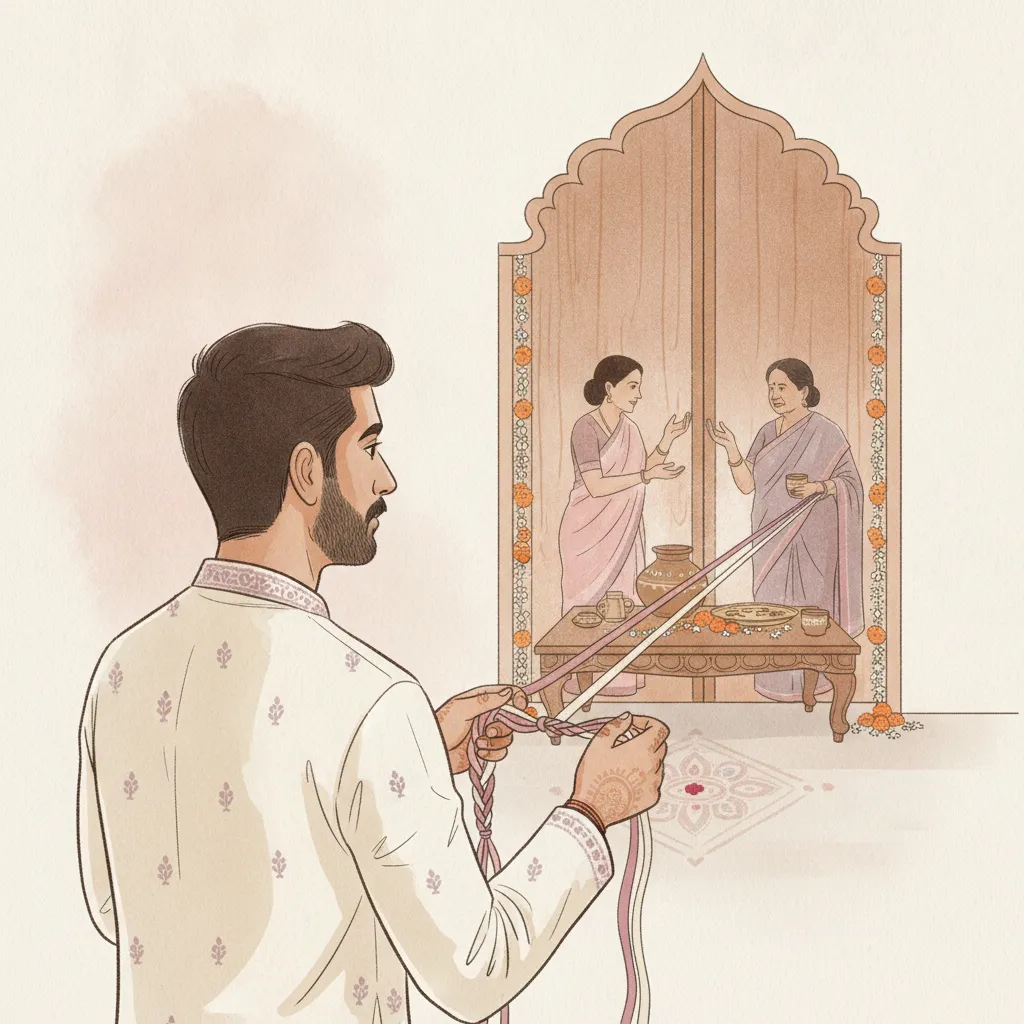
You are about to make the most significant transition of your adult life: from being primarily a son to becoming a husband. You are not losing the first role, but you are choosing to build the second. The challenge is that for many Indian men, these two identities are presented as a zero-sum conflict, a battle of loyalties between the woman who raised you and the woman you will build a life with.
The most common advice—to “balance” both relationships—is also the most useless. It offers no framework for when a conflict is real and a choice must be made. This is that framework. It’s not about choosing a person; it’s about choosing a principle: the primary duty of a husband is to protect the integrity of his marriage. This is not an act of rebellion against your parents, but the fundamental act of construction for your new life.
After reading this, you will be able to distinguish between genuine parental care and a bid for control, understand the destructive effect of making your wife your messenger, and have the exact words to use when you need to be a buffer for your new family.
The Architecture of a New Family
Think of it structurally. A marriage is not about your wife being absorbed into your family of origin. It is about the two of you leaving your respective families to create a new one. This new unit—your marriage—is now the central one you are responsible for. It exists in deep relationship with both families of origin, but it is not subordinate to them. You are not adding a member to your parents’ team; you are the co-captain of a new one.
This distinction is everything. When your mother offers “helpful” advice on how your wife should run the kitchen, manage her career, or spend money, the question is not whether the advice is good. The question is, who is responsible for the architecture of your home? If you treat your wife as someone who must adapt to pre-existing rules set by your parents, you have already made her a guest in her own life.
Consider Rakesh, a 39-year-old widower from Jodhpur with a ten-year-old son, preparing to marry Anjali. His mother, with the best of intentions, began sketching out a daily schedule for Anjali, detailing when she should help his son with homework, what to cook for tiffin, and when to be home from her job. It was a script for a daughter-in-law, written from love but also from a place of established control.
Rakesh intervened early. "Ma, I love that you're thinking about how to make things work," he told her gently. "But Anjali and I need to find our own rhythm first. We'll be a team, and we'll figure out the schedule and the cooking together. We'll ask you for your famous dal recipe when we're ready." He didn’t reject his mother; he affirmed his new team. He established that the blueprint for his new family would be drawn by its two members.
Reading the Field: When "Help" is a Bid for Control
In the early stages of a match, behaviour is data. Small comments and seemingly innocent questions are often probes, designed to see where the boundaries of the new relationship will be drawn. One of the most common patterns is when a parent frames their preferences as “concern” for their child’s well-being, directed at the future spouse.
This is a move you must learn to read. Imagine your mother says to your fiancée, "I'm just so worried Sameer won't get a hot breakfast if you have to leave for your nursing shift at 7 AM. He needs a good start to his day."
Let's break this down. The stated intent is care for you. But the effect is to place your fiancée in a position of evaluation. It frames her as a service provider whose schedule might lead to a failure in her duties. It subtly recasts you, a grown man, as a dependent who requires careful management. The conversation is no longer about two adults coordinating their lives; it’s about your fiancée’s adequacy. This scene is framed with a mother and a fiancée, but the dynamic of using 'concern' to install control is not tied to gender; a bride's father can play the exact same role with a future son-in-law.
This comment is a probe. It’s testing you. What will you do? If you nod along or say, “Yes Ma, you should teach her,” you have taught both women that your mother is the ultimate authority on your needs and your wife is the trainee. You have established a hierarchy with your marriage at the bottom.
An ordinary person does this out of habit and genuine anxiety. After decades of being your primary caretaker, your mother is navigating a profound role shift. Her identity is in flux. The extractive version, however, is a strategic move to maintain primary influence, to ensure her standards and preferences remain the governing law of your life.
The innocent version of this behaviour is a one-off question about a favourite dish or a legitimate health concern. It becomes a pattern when the "concern" is consistently used to critique your partner's choices across multiple domains—food, money, social life, her career—and persists even after you've stated that you, as a couple, have it handled.
Your counter is not to be aggressive, but to be clear. "Ma, don't worry about breakfast. Priya’s work is important, and we've already figured it out. I'm perfectly capable of making my own tea." This response does three things at once: it reassures your mother, it defends your partner’s choices without making her do the defending, and it asserts the autonomy of your new family unit. It’s a boundary drawn from a place of calm strength.
The Proxy War: Do Not Make Your Wife Your Messenger
The single most common and destructive mistake a man makes in this dynamic is to become a passive messenger. He hears a complaint from his mother and dutifully relays it to his wife: "My mom thinks we're spending too much on Swiggy." He hears a frustration from his wife and reports back to his mother: "Priya feels you're being too critical of her cooking." He thinks he is being a neutral communicator, but he is actually abdicating his role entirely. By refusing to be a principal in the conversation, he forces the two most important women in his life into direct conflict and leaves his wife to fight alone. She becomes the "difficult" one, the one who has to say no, while he preserves a false peace.
This is not neutrality; it is a profound betrayal of the partnership. Your wife did not marry your mother. She married you. Your mother's issues with the new shape of your life are issues she has with you, her son. It is your job to manage that relationship and absorb that friction. When you pass her complaints directly to your wife, you are using her as a shield.
Let's run the tape forward on this. A 27-year-old in Patna, preparing for his civil services exam, lets his wife, a new bride in the house, handle all his mother's daily comments about the household budget. At month six, his wife is quietly resentful. She feels less like a partner and more like a harried manager, forced to justify every rupee. He thinks things are fine because the arguments have stopped. But the silence isn't peace; it's the sound of his wife giving up on him as an ally. By year three, she has a separate account she doesn't talk about, a small financial world of her own, created not for independence but for sheer survival. The boundary he refused to draw with his mother has now become an invisible wall inside his own marriage. He outsourced the conflict, and in the process, outsourced the trust.
Establishing the New Alliance
Being a united front does not mean being hostile to your parents. It means that you and your wife make your primary decisions in private first, and then present them as a unit.
Decide Privately, Announce Publicly
When you anticipate a point of friction—where to live, how to handle finances, whether your wife will work after having a child—it is your responsibility to have that conversation with your partner first. Align on your non-negotiables. What is the plan you two are making? Once you have that, you can present it calmly. This moves the conversation from your family debating your future to your family being informed of it.
Look at the difference this makes. Karan, a 32-year-old schoolteacher in Indore, met his fiancée Divya's family. In the first meeting, her father asked pointed questions about his plans to leave his "stable but low-paying" job. Karan, caught off guard, gave a vague, non-committal answer. The father saw an opening to exert influence. Before the second meeting, Karan and Divya had a long talk. When the father raised the issue again, Karan’s answer was different. "Divya and I have talked about this at length. We've decided the stability and community I have at the school are very important to our plans. We're building our financial future around our combined income, not a hypothetical one." The content was the same, but the alignment had changed. Her father wasn't talking to a man he could sway; he was talking to a couple that had already made a decision. He was talking to a team.
Be the Buffer, Not the Megaphone
Your words frame the dynamic. When you speak to your parents, use "I" and "We."
-
Instead of: "Priya wants to get her own apartment."
-
Try: "I've been thinking, and I believe it's time for us to have our own space to start our married life. We are looking at places nearby."
-
Instead of: "Priya says she's too tired to come over on Sunday."
-
Try: "We've decided to keep our Sundays free just for us to rest and reconnect. How about we come for dinner on Saturday instead?"
This small shift in language is monumental. It takes the perceived blame or desire off your wife and places the decision squarely on you, or on the two of you as a unit. You are setting a boundary, but you are owning it. This is the essence of How Setting Boundaries Early Earns Long-Term Respect, because you are demonstrating that you are the leader of your own life.
This dynamic runs both ways. Sunita, 34, runs her family’s textile shop in Coimbatore. Her fiancé, Anil, is moving there. Her father starts "advising" Anil on investing his savings, strongly suggesting he join the family business. Anil is feeling the pressure. Sunita steps in. She speaks to her father privately: "Appa, I know you are just trying to help Anil. But he needs to feel like my partner, not your junior. Let's give him space to figure out his path. His career and his money are ours to discuss, together." She is being the buffer for him, just as he must be for her.
The Questions That Tell the Story
Sometimes, the most important data is in what is not said. Pay attention to the negative space in your conversations.
You have been speaking to a potential match for weeks. You know about her job, her friends, her favourite movies. But has she ever shown genuine curiosity about your relationship with your mother? Not the logistical questions like "Is your mom very traditional?" but human questions: "What's your mother like? What does she enjoy doing? What's your favourite memory with her?" A consistent lack of curiosity about the most important people in your life can be a signal that she sees your family as a set of conditions to be managed, not as people to be known and loved.
The reverse is just as telling. When your mother meets your fiancée, what does she ask about? Does she only ask about her ability to cook, her salary, her family's status? Or does she ask what your fiancée is passionate about, what she's proud of, what makes her laugh? The questions people ask reveal the role they are mentally casting for the new person entering the family. Are they hiring for a position, or are they welcoming a person? This is a crucial distinction to make before you get to conversations where you realize Why 'Yes to Kids' Is Not Enough in an Arranged Marriage.
The Cost of Each Error
As you stand at this junction, you face two potential errors. It is vital to weigh them honestly.
The first error is setting a boundary too bluntly or too soon, and in doing so, hurting the mother you love. You risk creating a period of tension, of her feeling that you are choosing "that woman" over her. This is a real cost. It feels like a violation of a lifetime of love and duty, and it can cause real pain to both of you.
The second error is failing to set the boundary at all. The cost here is not a single, painful conversation, but a slow, corrosive poisoning of your marriage. By staying silent, by making your wife the messenger, by consistently prioritizing your parents' comfort over your marital alignment, you teach your wife that she is, and always will be, second. You show her that you are not a safe harbor, that she cannot count on you to be her partner when it matters. The cost is the foundation of your marriage.
One path involves a difficult, painful period of adjustment for your family of origin. The other path risks the quiet, comprehensive failure of the new family you are trying to build. Choosing the former, with love and respect but with unwavering clarity, is the first and most important job of a husband.