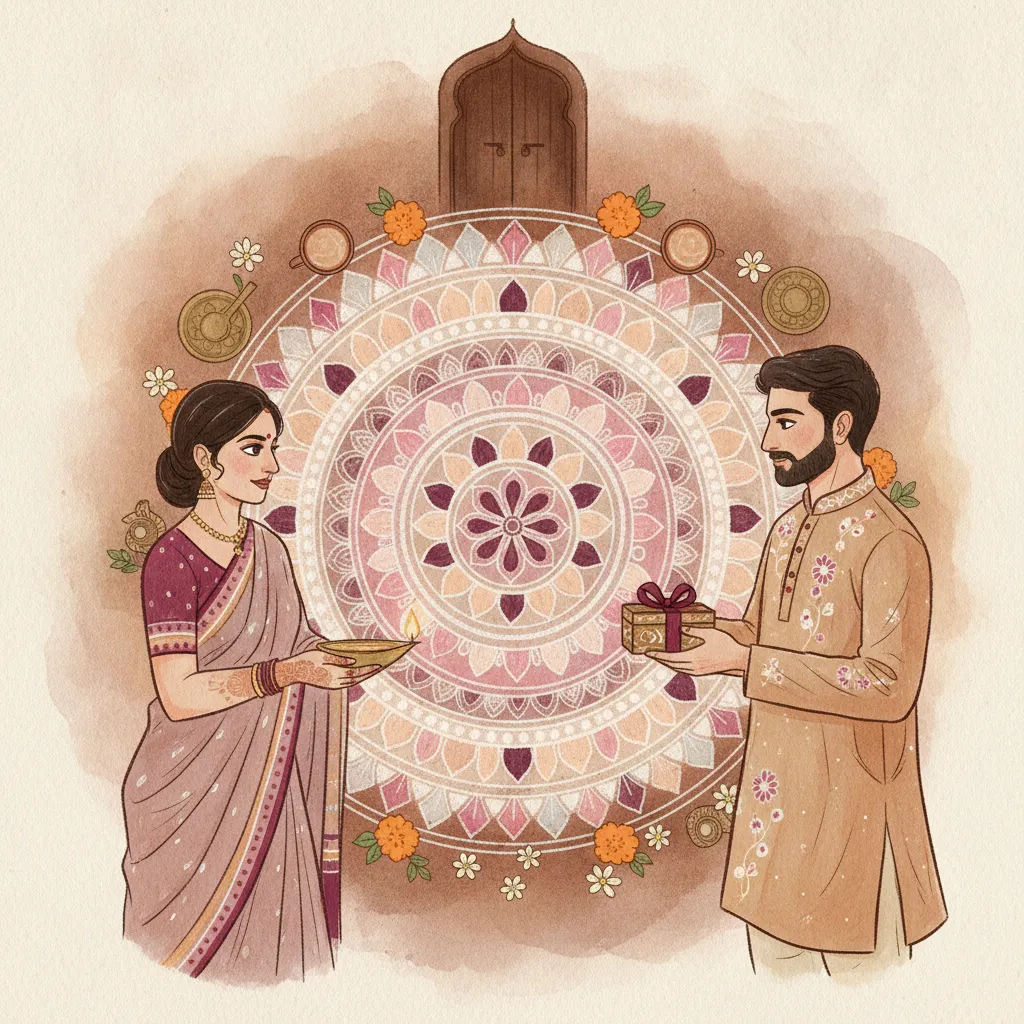
An expensive gift arrives on your third meeting. A phone, a designer handbag, a weekend trip booked and paid for. It feels good. It feels like being valued, chosen, seen. And it can be exactly that: a straightforward expression of growing affection from a person with the means to show it.
But it does something else, too, whether the giver intends it or not. It quietly changes the question you are supposed to be answering.
The question was, "Who is this person, and can I build a life with them?" The gift, sitting on your table, starts to substitute a different one: "What kind of life does this person offer, and do I want it?"
These are not the same question. The second one is easier to answer, and that is the danger. This is not about spotting manipulators, though the technique works for that too. It’s about understanding the mechanics of generosity in the accelerated timeline of a matrimonial search, so you can keep your focus on the person, not the package they arrive in. Generosity does four things to a relationship. Only the first one is affection.
The Four Quiet Jobs of an Early, Large Gift
When a significant gift arrives before a significant connection, it isn't just a present. It's a broadcast that sets the terms of the relationship. It’s performing a function, and your job is to see the function, not just the object.
1. It Denominates the Relationship in Money
Ritu is 39, a schoolteacher in Indore, meeting a successful hardware supplier. On their fourth meeting, he presents her with the latest iPhone, a ₹90,000 gesture. She is touched, and a little overwhelmed. What has just happened is that the currency of affection has been established. Every future gesture, from both of them, will now be unconsciously measured against this baseline. A thoughtful, small gift from her might feel inadequate. A simple coffee date might feel like a step-down. The relationship is now, in part, transacted in a language of price tags. This isn't his intent. It is the effect. The question is not "is he a good man?" but "what has he just taught you about how value is demonstrated in his world?"
2. It Creates an Obligation Debt
A gift always creates a small, unspoken debt. Not of money, but of obligation. The next time you need to say "no" — to a fifth meeting you’re unsure about, to a family introduction that feels too soon, to a physical boundary — that "no" now carries a higher price. It feels ungrateful. You will have to push past a feeling of indebtedness to state a simple preference. This is a probe, whether intended or not. Your response teaches the other person how easily you can be placed in a position of social debt. Does a simple, polite "no" come easily to you, or does their generosity buy your compliance on small matters? They learn this from your reaction.
3. It Pre-empts Evaluation
Gratitude is a powerful, warm, connecting emotion. It is also a terrible state of mind in which to conduct a clear-eyed assessment of someone's character. Receiving a large gift makes you grateful to the person, which subtly discourages you from being critical of the person. Your mind shifts from observation mode ("How do they handle stress? Are they kind to people they don't need to impress?") to reception mode ("This was so thoughtful. They must be a good person."). The gift acts as a substitute for character evidence, and we often let it. An in-the-moment self-check when you receive such a gift is to ask: What did I know about this person's character five minutes ago? And what do I know now? The answer is often that nothing has changed, only your emotional state.
4. It Fixes the Roles of Giver and Recipient
The dynamic of giver and recipient, established early, is one of the hardest to renegotiate later in a marriage. One person provides, the other receives. One person has the resources, the other has the gratitude. This can seem appealing, even secure, at the start. But it is a power dynamic. Two years later, when you want an equal say in a major financial decision, you may find the precedent was set before you were even married. The person who was the provider then may unconsciously expect to be the decider now. Their role is to give; yours is to appreciate. A pattern of early, unilateral generosity isn't just about the gifts; it’s a rehearsal for future roles.
The Question That Gets Replaced
These four effects combine to shift the very frame of your search. The focus moves from the person's character to the lifestyle they enable.
Consider Karthik, a 45-year-old widower running his family's textile shop in Coimbatore. His daughter is in middle school. He meets a woman whose family is in construction, and she is independently wealthy. She insists on paying for every five-star dinner. On their third meeting, she "surprises" him by paying off the lease on his modest car and arranging for a new, high-end SUV to be delivered. "You work so hard," she says, "you deserve something better." When his sister later asks him what he likes about her, Karthik finds himself saying, "She's so generous. She takes care of everything. We went to this amazing resort last weekend..."
He is no longer describing a person. He is describing a provider, a role Karthik found himself falling into just as easily as Ritu did in Indore, because the pattern is the point, not the gender of the person running it.
The most useful diagnostic question you can ask yourself is this: If I had to describe this person to my closest friend, without mentioning their job, their income, what they own, or a single thing they have given me or paid for, what would I say?
If you are left with a long list of traits—their sense of humour, the way they listen, their loyalty to their friends, their patience with your anxieties—you are on solid ground. If the page is mostly blank, you have your answer. You are not connecting with a person; you are being recruited for a lifestyle.
Resetting the Terms Without Causing Offence
So what do you do when faced with a grand gesture from a potentially decent person, inside a family culture where generosity is a virtue? You don't want to insult them, but you cannot afford to have the question changed.
The move is a gentle, firm reset that is about your comfort and the stage of the relationship, not their character.
The script sounds like this:
"This is incredibly generous of you, and I'm genuinely touched. Thank you. But for now, I’d be much more comfortable if we kept things simple and focused on getting to know each other. Your time and conversation are the real gift for me right now."
This response does two things. It validates their generosity while clearly defining the terms you need for a healthy evaluation. Now, you watch their response.
A well-calibrated person, whose generosity is genuine, will respond with ease. They will say, "Of course, I understand completely. No problem at all." They will not bring it up again. The refusal will be frictionless. They were offering a gift, not running a test.
A person for whom the gift was a tool will reveal it here. Their response will have friction. It might be a bit of teasing ("Don't be so formal!"), insistence ("No, no, I really want you to have it"), or a subtle emotional withdrawal. If they agree, but later reference the rejected gift, even as a joke ("Remember that watch you were too proud to accept?"), they are showing you that the gift was not a gift. It was a transaction, and it remains on the ledger. Genuine generosity is amnesiac; transactional generosity keeps detailed records.
When navigating these early stages, it helps to be clear on how to manage the financial conversations that will eventually define your life together. Understanding the money talk that sets your entire wedding budget is a skill that grounds the relationship in reality, not just grand gestures.
The Lifestyle Ratchet
A more subtle version of the expensive gift is the expensive courtship. This happens even with the best intentions.
Anjali is 24, a serious civil services aspirant living in Patna. Her family connects her with a man working in tech in Bangalore. For their meetings, he flies in. Each weekend is a whirlwind of the city's best restaurants, expensive events, and short trips to nearby resorts. He is spending his own, honestly-earned money. He is genuinely trying to impress her and show her a good time.
The problem is not his intent, but the baseline this creates. Their entire relationship is being built in a "holiday mode" that bears no resemblance to the daily life they would actually lead. The risk is that after marriage, the return to a normal Tuesday night of dal, roti, and balancing the budget will feel like a shocking downgrade. It feels like a promise has been broken, even though no promise was made. This is the lifestyle ratchet: each experience sets a new, higher bar, and it becomes difficult to dial back without it feeling like a loss.
The fix is to consciously introduce normalcy into the courtship.
Ask this specific question: "This has all been so wonderful. For one of our next meetings, I'd love to do something completely ordinary. Maybe we could try cooking a meal at home, or just go for a long walk in a neighbourhood park. Would you be up for that?"
A straight answer sounds like: "That's a great idea. I'd love that. What should we cook?" The focus is on the shared activity, the "we."
An evasive answer deflects or tries to upgrade the plan: "Oh, we don't have to do that, I can take you somewhere much nicer." Or, "Maybe, but there's this new place I really wanted to show you first."
Pay attention to who resists the ordinary. The person who only feels connected to you in expensive settings is telling you something important about where they locate value. A partner for a whole life must be a partner for the boring days, because that is most of what a life is. This is a core part of figuring out if you are choosing someone to build with, or simply opting for a pre-built life that looks 'well-settled'.
The Clarity That Costs Nothing
The point of this is not to become suspicious of kindness. It is to stay in charge of the question you are answering. The matrimonial process is full of pressures to assess quickly based on visible, material signals. Your most important task is to resist this and insist on seeing the person behind the signals.
The ultimate evidence that you are on the right track, that the generosity is a feature of the person and not a substitute for them, is simple. It is a person who is just as warm, just as engaged, and just as present when you are doing something that costs nothing at all. It is someone who hears your boundary about gifts and respects it instantly and completely. It is someone whose affection is not contingent on your gratitude. Their presence is the present. When that is true, you can relax and trust the connection that is building. That is the clarity you are looking for, and it costs nothing to find.