The Tell Before the Turn: Recognising a Controlling Partner in the Matrimonial Process
In the compressed timeline of a matrimonial search, we learn to read people quickly. We look for shared values, family compatibility, and that spark of connection. But the one pattern we are rarely taught to see is the one that matters most, because it almost never announces itself. It arrives disguised as its opposite.
Deep care can look like intense attention. A desire for commitment can resemble a need for constant contact. The very qualities that feel reassuring in the first few meetings—attentiveness, certainty, a desire to protect and provide—can also be the soil in which control takes root. The pattern of control doesn't begin with a demand; it begins with a test disguised as a gesture of love. This article is a guide to recognising those tests for what they are, allowing you to distinguish a partner who wants to build a life with you from one who wants to build a life for you, on their terms.
The Test Disguised as Transparency
The first probes for control are rarely about big decisions. They are small, reasonable-sounding requests that test your willingness to dissolve personal boundaries in the name of "us." They often appear in the emotional high-tide of the engagement period, when refusing a gesture of intimacy feels like rejecting the person themselves.
Consider Ajay, a 32-year-old financial analyst from Mumbai, meeting his fiancée, Kavita, a graphic designer. A few weeks after their families have met and approved, Kavita makes a suggestion over coffee. “I feel like we’re so close already,” she says. “We should share our phone passwords. Not because I don’t trust you, but because in a marriage, there should be no secrets. It’s about total transparency.”
This request, seemingly about trust, operates on a deeper level. The move is to frame access to a private space not as a matter of privacy, but as a referendum on the relationship’s health. The vocabulary—"transparency," "no secrets"—immediately reframes the conversation. The issue is no longer “Do we both deserve private, individual space?” but “Are you willing to prove your trustworthiness?” This tactic makes a personal boundary seem like a relational barrier, shifting the burden of proof onto Ajay. If he says no, he isn't protecting his privacy; he is "keeping secrets." He must now justify a normal boundary, and any justification sounds defensive.
What Kavita is doing, consciously or not, is conducting a measurement. She is learning something crucial about Ajay’s internal architecture. Does he have a strong sense of self that exists independently of the relationship, or can his boundaries be redefined by an appeal to "us"? His response teaches her which kind of appeal is most effective. If he agrees, he has taught her that invoking the ideal of a "perfectly open marriage" is a reliable way to get him to concede personal territory. This scenario shows a woman initiating it; reverse the roles, and the underlying mechanics of the test remain identical.
The motivation could be profound insecurity, perhaps a clumsy attempt to feel safe after a past betrayal. But the extractive motive is to establish a precedent of access. Information is a prerequisite for control. Gaining access to who you talk to, what you say, and what you spend money on is the foundational step before attempting to influence those things.
A healthy response doesn't need to be a confrontation. It is a calm clarification of principles. Ajay could say, "I am 100% committed to building a life with you, and that includes being honest and open. For me, trust is built on that, not on giving up the basic privacy we both deserve. My phone is my space, just like yours is yours. Instead of sharing passwords, let's talk about what we both need to feel secure in this relationship." This affirms the relationship while holding the boundary, and it shifts the focus to the real issue, which is a feeling of insecurity.
The innocent version of this impulse looks like a request for reassurance, not access. A partner who feels anxious might say, “I sometimes get a bit worried when you’re out late with your friends and I don't hear from you. Could you just drop me a quick message when you’re heading home?” This is a request for a specific, comforting action. It is not a request for the keys to your entire digital life. One is a bid for connection; the other is a bid for oversight.
The Outsourced Demand: "My Family Thinks..."
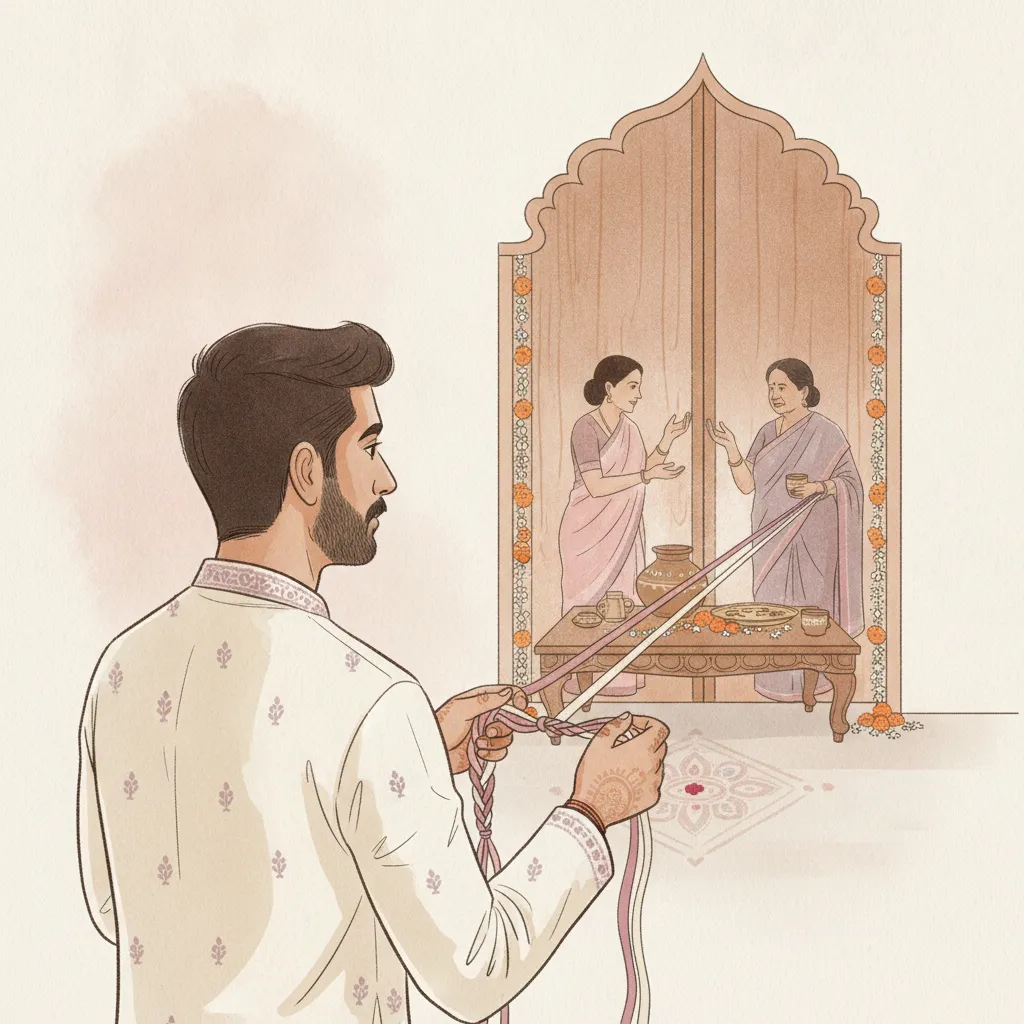
In the Indian context, the family is not a peripheral player; it is the stage on which the marriage is built. This creates a unique opportunity for a controlling partner to outsource their demands, using their family as a shield and a lever. The phrase “My parents were just wondering…” or “My family feels…” is one of the most powerful and subtle control tactics you will encounter.
It works by turning a direct, two-person negotiation into a complex, multi-party problem where you are positioned against their entire family.
Imagine Rohan, a 34-year-old architect from Hyderabad, is discussing finances with his fiancée, Meera. They had agreed to live in his existing flat for the first few years. Then, Meera raises a new point. “My parents were asking about the flat,” she begins. “They feel that since you bought it before we met, it doesn’t really feel like ‘our’ home. They think it would be better for us to sell it and buy a new place together after the wedding.”
The demand isn't coming from Meera. It's coming from her parents. This construction is deliberate.
- It absolves her of responsibility. She is merely the messenger, the reasonable go-between. Any objection Rohan has is not with her, but with her "traditional" or "anxious" parents. She gets to remain the supportive partner while forwarding a demand that dramatically alters their agreed-upon life plan.
- It raises the social stakes. Disagreeing is no longer a simple financial discussion between two people. It's now perceived as Rohan dismissing the feelings and wisdom of his future in-laws. It pressures him to be accommodating, not for Meera’s sake, but for the sake of familial harmony.
- It’s a test of allegiance. The unspoken question is: Whose needs will you prioritise? Your pre-existing plans and financial stability, or the anxieties (real or invented) of my family? A partner who consistently uses this tactic is training you to place their family's desires at the centre of your joint decision-making.
This same mechanism is frequently applied to finances, particularly a woman’s salary. When Sneha, a 28-year-old marketing manager in Delhi, mentioned her monthly salary of ₹95,000 to her fiancé Rahul’s family, his father later took him aside. The next time they met, Rahul said, "My parents were very impressed with your career. They were just wondering, as a matter of good financial planning for the new family, how much of your salary you would be contributing to the joint household expenses." The request is framed as prudent planning, but it's a test of financial autonomy. It establishes an expectation that her earnings are not her own, but a resource to be managed by the family unit, with decisions being made for her, not with her.
A key diagnostic tool here is observing what is not said. This is a negative-space observation. Does your partner ever say, “My parents can be a bit old-fashioned, but you and I need to decide what’s best for us”? Or, “I understand their concern, but I’ve told them we have a good plan and they need to trust our judgment”? The absence of this kind of statement—the failure to create a boundary between "us" and "them"—is the real signal. It indicates they see their family’s desires and their own as one and the same, and expect you to do so as well.
The innocent version of this is direct and collaborative. "I've been thinking about the flat. While I love it, I'm worried that because it was your space first, I'll always feel like a guest. It's important to me that we build our first home together. Could we talk about what that might look like, even if it's a few years down the line?" Here, the feeling is theirs, the "I" statement is clear, and the request is for a conversation, not a solution presented as a fait accompli from their family.
The Most Reliable Signal: The Changes in Your Own Behaviour
Often, the clearest sign of a controlling dynamic is not in what your partner does, but in what you stop doing. It’s the subtle, pre-emptive self-censoring that becomes a habit. You start managing their moods by editing your life.
Think about the difference between your first meeting and your fifth. This is the two-meeting diff, and it can reveal a trajectory.
When Priya, a 29-year-old consultant in Pune, first met Sameer, she was open and excited about a potential promotion that would involve significant international travel. She saw it as the culmination of years of hard work. By their fifth meeting, after Sameer had made a series of "jokes" about how lonely he’d be and how "other husbands" wouldn't be so "understanding," Priya found herself describing the opportunity differently. She told him it was “just a small project with a bit more responsibility.” She didn’t lie. She just shrank her achievement to fit the space he was willing to give it.
She had learned, without a single explicit command from him, that her ambition was a source of his disapproval. To avoid that disapproval, she began to dim her own light.
This is the pattern. Before the wedding, before you even live in the same house, you are already walking on eggshells. You rehearse conversations in your head. You edit good news. You find yourself giving vague answers to your closest friends about how things are going, because the specifics would invite questions you aren’t ready to answer.
If you are already managing someone's anger or disappointment before you are legally bound to them, you are looking at the blueprint for your future. The control isn't in their "no"; it's in the fact that you no longer feel free to ask.
Patterns to Recognise
Here are some specific, early behavioural patterns to observe. A single instance is just a data point; a cluster of them is a trajectory.
-
Disproportionate Reactions to Small Boundaries. The mechanism here is to catastrophise normal, logistical needs, reframing them as personal rejections. You say, "I'm a bit busy at work, can I call you back this evening?" and they respond with hurt or suspicion: “Who are you with? I guess you don’t want to talk to me.” The goal is to make the price of setting even a small boundary so high—an argument, a guilt trip—that it becomes easier to simply have no boundaries at all. The innocent twin is proportional disappointment followed by respect for the boundary: "Ah, I was hoping to catch you. No problem, let's talk tonight."
-
"Help" That Undermines. This isn't just offering advice; it's a pattern of unsolicited 'feedback' that positions them as the expert on your life. The mechanism is to disguise criticism as care. "I'm just trying to help you," they say, after commenting on your clothes, your career choices, or the friends you keep. The underlying message is that your judgment is flawed. The innocent twin asks for permission before offering guidance: "I have a thought on that, if you're open to hearing it?" or offers help that empowers, rather than corrects you.
-
Accelerated Intimacy and Early Monopolisation. The mechanism is to create an intense, isolated emotional bubble quickly. They push for declarations of love, commitment, and exclusivity very early on, and subtly create friction around your existing support system—friends, family, and hobbies. "Why do you need to see them again? We have each other now." The aim is to make them the centre of your world, magnifying their influence before you've had time to properly assess them. The innocent twin is genuine enthusiasm that seeks to join your world, not replace it: "I can't wait to meet the friends you're always talking about!"
-
Public Surveillance Disguised as Online Affection. In modern relationships, social media becomes a powerful tool for this. The mechanism is using public platforms for private monitoring and loyalty tests. Vikram constantly checks who likes his fiancée Ananya’s photos and questions her about any male names he doesn't recognise. He insists they create a joint Instagram account as a sign of "total commitment." The innocent twin is a partner who enjoys sharing a life online but respects individual space. They might say, "I'd love it if you tagged me in that photo because we look so happy," not "Why didn't you tag me? Are you trying to hide something?"
-
The Scorecard. The mechanism here is to turn the relationship into a transaction, converting acts of care into a debt that can be called in. Every favour, gift, or compromise is mentally logged. During a disagreement, the list is produced: "After all I've done for you, you can't do this one small thing for me?" This makes it impossible to disagree without seeming ungrateful. The innocent twin is a partner who feels unappreciated and expresses it with a vulnerable 'I' statement: "I'm feeling a bit taken for granted lately," which invites a conversation, rather than presenting an invoice.
Ask Yourself This Week
If any of this feels uncomfortably familiar, take a moment to reflect. The goal is not to seek out faults, but to see the existing dynamic with clarity.
- Is there a topic (a friend, a hobby, a career goal) you consistently avoid mentioning for fear of their reaction?
- When was the last time you said "no" to a request of theirs, big or small? What was their immediate response? Did they respect it, or did they try to negotiate, guilt, or challenge it?
- Think of the person you were in your first meeting. Are you more or less yourself with this person now?
If you are considering ending an engagement because these patterns are becoming clear, please confide in a trusted friend or family member before you act. The moment of leaving can be a high-risk time, and having a support system in place is the most important first step.