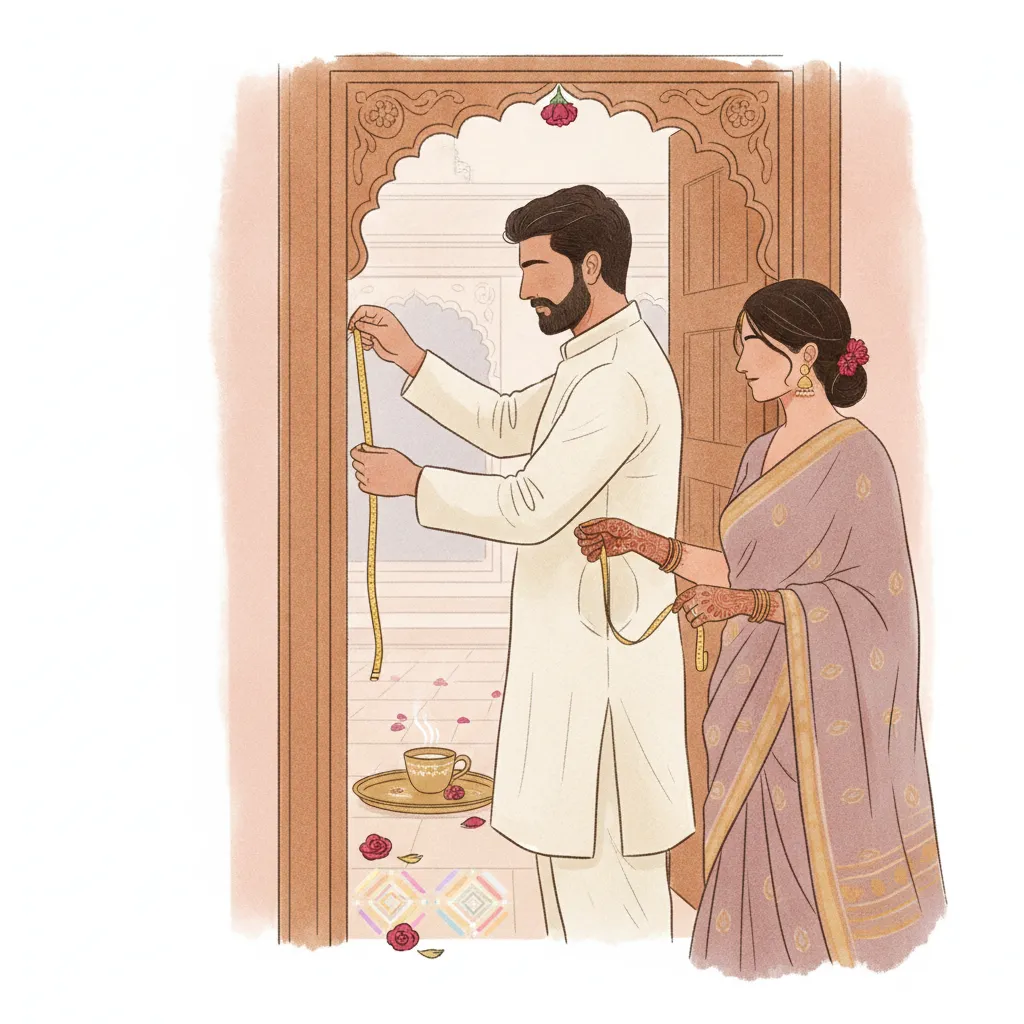
You are 26, sitting at the dinner table. Your parents are talking about a cousin’s engagement, the third one this year. You hear the familiar cadence: the praise for the family, the speculation about the wedding, the unspoken question hanging in the air like the scent of jasmine from the garden. When is it going to be your turn? But they don't ask. And you don’t answer.
In many Indian homes, the conversation about marriage is one you wait to receive. It arrives like a summons, a formal recognition that a new season of your life is about to be declared open by those who have, until now, managed the calendar. To begin it yourself feels like breaking a rule you never read but have always understood. It feels impatient, overly eager, or worse, like an admission that you’ve been thinking about it all along.
So you wait. You wait for them to decide it’s time. But what if you are already there? What if the readiness is yours, and the only thing missing is the conversation? Starting that dialogue is not an act of impatience. It’s the first real decision you make as the architect of your own married life: choosing the moment you lay the foundation stone, rather than waiting for someone to hand you a trowel.
The Conversation Is an Invitation, Not a Demand
Why does this conversation feel so freighted with risk? Because we mistake its purpose. We imagine it as a formal declaration of intent—“I want to get married by next year”—which frames it as a demand. This puts you in a position of asking and your parents in a position of granting or denying. It instantly creates a hierarchy where you have to win approval.
A more effective and honest approach is to reframe it as an invitation. You are not announcing a fixed outcome; you are inviting them into your thought process. For Anjali, a 23-year-old running her family’s textile business in Jodhpur, this shift in perspective was everything. She’s been in a serious relationship for two years, one her parents are vaguely aware of but have filed under “college friend.” She felt stuck. The conversation she needed to have wasn’t, “I want to marry Rohan.” The conversation was, “I’m at a stage where I’m thinking seriously about my future and who I want to build it with. I’d love to talk to you both about that.”
This approach does several things at once:
- It centres your readiness, not a specific person. This makes it about your life stage, a fact they can see and respect, rather than a choice they might feel pressured to approve.
- It honours their role. By asking to talk, you are acknowledging their place in your life without ceding your agency. You’re opening a door for collaboration, not asking for permission.
- It prepares the ground for either path. For those in a relationship, it creates space to introduce a partner. For those looking for a family-introduced match, the opening is not “Find me someone,” but “I think I’m ready to start meeting people. Can we talk about what that would look like?”
The goal is not to get a “yes” in the first ten minutes. The goal is to successfully open the topic for discussion, turning it from a silent, high-stakes assumption into a normal, spoken-aloud part of your family’s reality.
Choosing the Right Door to Knock On
“We need to talk.” A formal, sit-down meeting announced with this phrase is almost always a mistake. It loads the moment with pressure and forces everyone to have an immediate, official position. The setting and timing of this conversation can determine its outcome before you’ve said a single word. Instead of a summons, you are looking for a moment of casual connection, a low-stakes opening where a serious seed can be planted without drama.
Think of it as finding the right soil. You wouldn’t plant a banyan tree in a teacup. A long car ride, a quiet moment after a family dinner, a walk in the park—these are the spaces where a thought can be introduced gently.
Rohan, a 27-year-old software developer in Patna, understood this instinctively. For years, whenever his family brought up marriage, his answer was the same: he was too focused on his career. Now, having saved aggressively and secured a promotion, he feels ready, but he has to undo his own narrative. A formal announcement would seem abrupt. So, one evening while helping his father with taxes, he shows him his investment portfolio. “I’ve hit the savings goal I set for myself five years ago,” he says. “It feels good to be financially stable. It makes me think about the other parts of life, like the kind of partnership you and Ma have built.”
He didn't ask a question. He made two statements: one of financial maturity, the other of emotional readiness. His father, surprised, just nodded. But the foundation was laid. The subtext was clear: The reason I gave you for waiting is now resolved.
If a direct approach feels too risky, consider a time-honoured strategy: the trusted intermediary. A favourite aunt, an older cousin, or a family friend can be an invaluable ally. They can broach the subject in a casual conversation with your parents—“I was talking to Rohan the other day, he seems to be thinking more about his future these days”—and report back on the reaction. This allows you to gauge their mindset without spending your own political capital, turning a high-stakes confrontation into a low-stakes reconnaissance mission.
The script is less about the perfect words and more about the right emotional key. Often, it’s an anchor to a recent event.
- The Anchor: “Attending Priya’s wedding was so lovely. It made me realise I’m starting to look forward to that phase of my life.”
- The Request for Advice: “Aunty was asking me if I was ‘looking’. I didn’t know what to say. What do you think is a good way to answer that?”
- The Future-Oriented Observation: “I’ve been thinking about where I want to be in five years, and building a family is a big part of that picture for me.”
Each of these opens the topic without demanding an immediate action plan. It allows your parents to get used to the idea, to see you not as their child who needs to be settled, but as a young adult who is, quite maturely, planning their own life.
What Their Response Is Actually Telling You
So, you’ve spoken. What does their reaction really mean? It’s tempting to treat their first response as the final verdict, but it’s more useful to see it as an opening bid in a long negotiation. One instance is a reaction, often driven by surprise. A pattern that repeats over two or three separate, low-stakes conversations is a system. That’s the data you’re looking for.
You’re listening for whether their mindset is collaborative or prescriptive. The difference is audible.
Ask a direct but gentle question: "I feel I'm at a point where I'm ready to think about marriage. I wanted to know what your thoughts were."
- A collaborative answer sounds like: "We're so glad you brought this up. We were wondering, but didn't want to push. Tell us what you're thinking. Is there someone in your life, or are you thinking we should start looking? What's important to you?" This response is characterised by questions. They are curious about your internal world. That curiosity can manifest as palpable relief. For Aayush, a 30-year-old architect in Indore, his parents’ response was exactly that: “Thank God. We thought you weren't interested and we didn’t know how to ask.” His long silence had been misinterpreted as a lack of interest, not a patient waiting.
- A prescriptive answer sounds like: “I'm glad you're thinking about it, but let's get past this promotion cycle first so you can focus.” This response is characterised by a logical-sounding deferral. They are focused on their external plan for you.
A prescriptive response isn't a rejection; it's a re-prioritization, often rooted in love and a desire for your security. The wrong way to handle it is to argue the point ("My promotion has nothing to do with it!"). The right way is to validate their logic while holding your ground. A good reply is, “You’re right, that promotion is a top priority for me right now. That’s why I wanted to start this conversation now—so we can think about it slowly, without any rush. It’s not about finding someone tomorrow, it’s just about opening the conversation together.” This reframes your request as mature long-term planning, not impulsive desire.
But what if their objection is rooted not in a script, but in a valid, recent concern? If they say, "How can you think about this now, you just went through that awful breakup?" or "Your startup is on shaky ground, let's be realistic," do not dismiss their point. Address it directly. The answer is, “You’re right to be concerned. My emotional health is the priority. Part of feeling ready for the future, for me, is knowing I have your support in it when the time is right.” Acknowledging their wisdom is the fastest way to get them to listen to yours.
Pay close attention to what is consistently not said. This is a negative-space observation. If you tell your parents you've met someone, and in the next three conversations they ask about his salary, his company, and his parents’ background in meticulous detail, but never once ask, “What do you admire about him?” or “How does he treat you when you’re stressed?”—that absence is the message. It tells you their calculus for a "good match" is based on a spreadsheet of assets, not a foundation of character and emotional connection. This doesn't mean they don't care about your happiness; it means they believe happiness is a result of the right assets, and you may need to explicitly state your own, very different, needs.
The Conversation That Begins the Real Work
Let’s return to Anjali in Jodhpur. She’s at the dinner table, the air thick with the unspoken. She decides to use a casual anchor. “That resort where Priya is getting married looks beautiful,” she says. “It really makes you think about what a wedding like that means.”
Her father grunts, focused on his food. Her mother asks a few questions about the venue. It feels like a failure. But the seed is planted. The next afternoon, her mother comes into her workshop, looks at the block prints Anjali is designing, and says quietly, “I was thinking about what you said yesterday. About what it all means. When you’re ready to talk about Rohan properly, we are ready to listen.”
The conversation didn’t happen in one big, dramatic moment. It started with a tentative opening, and the real response came 18 hours later, in a quiet room, away from the formality of the dinner table. She didn't get an answer; she got an invitation back.
This is the most important lesson: the formal meeting is often not where the real decision happens. Your goal is not to win the argument in the moment. It is to plant a thought that can be revisited later, in a different context, on their terms. The real conversation often begins long after you think the first one has ended.