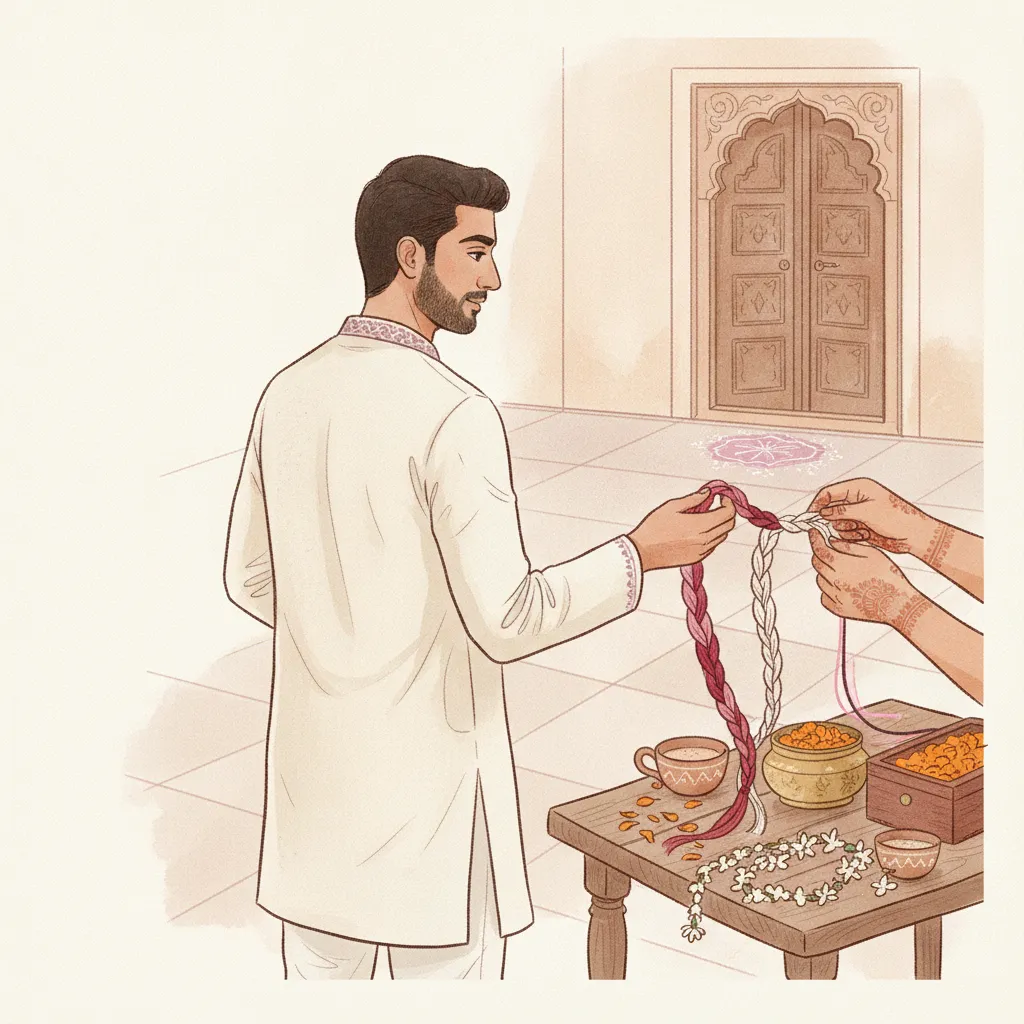
This is not about who washes the dishes or takes out the trash. You already know that a partnership requires sharing visible labour. This is about the work that happens before the task becomes a task: the noticing, the tracking, the planning, and the remembering. It is the mental spreadsheet of a home’s operating system. In most homes, one person maintains that spreadsheet. This article is about learning to see it, and then learning how to share it. Because a husband who only does the tasks he is handed is not a partner; he is an employee in his own home.
The Second Job You Don't Know You're Outsourcing
The transfer of this invisible job doesn't happen in a single, grand negotiation. It happens in a hundred tiny, silent moments of precedent. Consider Rohan and Priya, three months into their marriage in Pune. The first electricity bill arrives. Rohan sees it on the counter, picks it up, and says, “Oh, the MSEDCL bill is here. Due on the 20th.” Priya, sorting through groceries, replies without looking up, “Okay, I’ll pay it online tonight.” Rohan says, “Great, thanks,” and leaves the bill on the counter.
A month later, the next bill arrives. This time, Rohan doesn't say a word. He simply places it on the counter where Priya will see it. He has just, without a single word of discussion, transferred full ownership of ‘electricity bill management’ to her. He didn’t refuse to do it. He didn’t argue. He just created a quiet assumption that this was her domain.
This second layer of work is the mental load. It is a continuous, low-grade cognitive effort of anticipation and management. It’s not just paying the bill; it's remembering that bills exist, knowing when they are due, knowing where the money is to pay them, and making sure the payment happens on time. For most men, this work was modelled by their mothers, and the expectation—often unspoken, sometimes not even conscious—is that their wife will pick up that same responsibility. It is not a malicious expectation, but it is a profoundly limiting one.
Think about the work involved in having family over for dinner. There is the visible work: chopping vegetables, making the rotis, setting the table. This is the work of execution. Then there is the invisible work that came before it: deciding on a menu that accommodates your diabetic uncle and your sister-in-law who dislikes cauliflower. Checking the pantry to see what you have and what you need. Making a grocery list. Going to the store. Calculating what time you need to start cooking so everything is ready when the guests arrive. Remembering that your cousin’s son has a nut allergy.
These quiet transfers, like the electricity bill, accumulate. One for bills, one for remembering family birthdays, one for tracking the child’s vaccinations, one for scheduling the water filter service. Before you know it, one partner is the sole project manager for the entire enterprise of your life, while the other is a task-taker waiting for instructions. Handing this entire system to your wife, on top of her own career, is not creating a partnership. It is assigning a second, unpaid, and invisible job.
The Difference Between a Helper and a Partner
In the early stages of getting to know someone, you will see signals of how they view this division of labour. The most common one is not a refusal to help, but a refusal to own. It often sounds perfectly agreeable.
Praveen, a 45-year-old widower from Jodhpur, was surprised when this came up. Running his family’s textile shop and raising his ten-year-old son, he considered himself a capable, hands-on man. His first wife had managed the home’s inner workings, and he was now learning just how much that involved. While talking to a prospective match, a 41-year-old school principal named Aarti, he found himself repeatedly saying, "I’m happy to do whatever is needed, just tell me what to do."
He meant it as a sign of cooperation. But what Aarti heard was a man offering to be a subordinate in his own life. The "Just Tell Me What to Do" offer is a subtle but powerful move.
The effect is that it positions one person as the manager and the other as the helper. The manager retains 100% of the mental load—the planning, the delegation, the follow-up—while the helper gets credit for completing a task without ever having to own the outcome. It probes a boundary: will you accept the role of household CEO? If you consistently provide instructions, you are signalling that this arrangement works for you.
The motive can be innocent. A person may have been raised in a home where this was the norm and is simply replicating a familiar script. Or, the motive can be strategic: a way to outsource all cognitive labour while appearing helpful. This dynamic, described here with a man defaulting to helper and a woman holding the load, runs just as often in the other direction. The pattern is the behaviour, not the gender.
If you find yourself in this position, either making this offer or receiving it, the counter is not a complaint. It is a clear, kind proposal for a transfer of ownership.
Try this exact question: “I’d like to hand over planning our weekend meals completely. That means everything from deciding the menu on Friday, to making the grocery list, buying what's needed, and making sure we have it all. I’m happy to help cook, but I want the planning part off my plate. Can you take that on?”
Now, listen carefully to the two kinds of answers.
- A straight answer sounds like: “Okay, I haven’t really done that before, so I might get it wrong a few times. But yes, I can take that on. Let me try it this weekend.” This response acknowledges the full scope of the task (planning, not just doing) and accepts responsibility.
- An evasive answer sounds like: “Sure, just tell me what you want to eat and I’ll buy it.” or “Why make it a formal thing? We can just decide together as we go.” This response immediately attempts to hand the decision-making and planning labour straight back to you.
One answer builds a partnership. The other preserves the manager-employee model.
The Strategic Incompetence Play
A more calibrated version of offloading work is what’s known as strategic incompetence. This is not about refusing a task; it’s about accepting it and doing it just badly enough that you are never asked to do it again.
Alok, a 27-year-old running his family's small manufacturing unit in Indore, was excited that his fiancée, Sunita, a 24-year-old graphic designer, was keen on learning about investing. He suggested she take the lead on managing their joint tax-saving investments for the year. She enthusiastically agreed.
A month later, she presented her choice: a very conservative hybrid fund.
Sunita: "I looked at everything, and this one seems the safest. It has a good track record and low risk." Alok: “It’s safe, but look at the 5-year returns compared to this ELSS fund. We’re young, we can take more risk for a much higher potential return. We're losing out on growth here.” Sunita: "I know, but I get so nervous about the market going down. My head just spins with all these options. You just understand this stuff so much better. I think it’s probably safer if you just pick one.”
This is a masterclass in returning a task while appearing blameless. The move accomplishes several things. It transfers the domain of work back to Alok. It does so with a layer of logic (“you’re better at it,” "it's safer") and a hint of guilt (he can’t be upset, because she “tried” and was being “responsible”). It establishes a precedent that it is simply more “efficient” for him to do it.
This is a probe of his tolerance for friction. Will he take the task back to avoid the sub-optimal outcome? Or will he hold the boundary and insist that this is a shared skill they must both develop? Her incentive could be genuine anxiety about a subject she was never taught. Or it could be a highly effective, low-conflict way to offload a complex task. The line between the two is often blurred, which is why observing the pattern is more useful than judging the intent. A person who is genuinely struggling will ask clarifying questions and get incrementally better. A person engaging in strategic incompetence will make "sensible" errors that always conclude with the suggestion that you should take over.
Run this tape forward. If a partner uses this to hand back financial planning, they will use it to hand back booking travel ("you always find the better deals"). They will use it to hand back school admissions ("you're so much better with the paperwork"). The category of "things you are better at" will slowly expand to include every task that is difficult or tedious. This is how one person becomes the sole operating system for an entire family. For a partnership to be sustainable, you both have to be willing to be bad at things for a while.
Owning a Domain: The First Awkward Month
The solution to this imbalance is not a chore chart. A list of tasks still requires a manager to create the list and check that it’s done. The real shift is from task-based thinking to domain-based ownership.
Instead of “helping with the cooking,” you take full, end-to-end ownership of a whole area of household management. Pick one to start.
- Domain: All Family Health. You are now responsible for knowing when everyone’s annual check-ups are due, booking the appointments, tracking prescriptions and refills, managing medical insurance policies, and knowing where the first-aid kit is.
- Domain: All Household Bills & Maintenance. You track every due date for electricity, internet, gas, and society fees. You schedule and oversee all repairs and preventative maintenance for appliances, filters, and vehicles.
- Domain: The Social Calendar. You are the one who remembers birthdays and anniversaries for both sides of the family. You buy the gifts, you send the messages, you RSVP to weddings and functions.
When you take on a domain, you will be bad at it at first. You will forget things. The critical part of this transition is not just you stepping up, but your partner stepping back. This requires an explicit, collaborative conversation.
Try saying something like this: “Let's try an experiment. For the next month, I've got the groceries—all of it. That means menu ideas, the list, the shopping. And if I forget the salt, I have to be the one to run back out. Deal?”
This is where the experiment often gets tricky. Letting someone fail when the stakes are low—like a missing ingredient—is essential for the transfer of mental load. But what happens when their standard of "done" is fundamentally different from yours? This is the most common failure mode of domain ownership. It's one thing to forget the salt. It's another if your partner takes over the social calendar and buys a generic gift card for your mother's 60th birthday, or takes over maintenance and always hires the cheapest, shoddiest repairman who leaves the bathroom tap dripping for a second time.
This conflict—where one person’s “good enough” is the other’s legitimate problem—must be negotiated. The solution is to define the standard of completion as part of the domain itself. The domain isn't just "buy gifts"; it is "make our family feel thoughtfully remembered on important occasions." The domain is not "get the tap fixed"; it is "find a reliable plumber so we don't have to deal with this again next month." Agreeing on the outcome, not just the task, is the key. Without this, the manager will be forced to take back control not out of a desire to micromanage, but out of a need to prevent real-world consequences.
The Quiet Gift of Not Having to Ask
Why go through all this? The reward is not a gold star. Your wife will not, and should not, praise you for managing your own household.
The real payoff is a partner who is not exhausted. It is a wife who has the mental and emotional bandwidth to meet you as an equal, to talk about her day, to dream about the future, to be your friend—because she is not spending that energy managing you and the logistics of your shared life. The quiet gift of a true partnership is not having to ask. It is the peace of mind that comes from knowing the entire architecture of your life is held jointly, that someone else is also watching the horizon, anticipating the needs, and taking care of things before they become urgent.
This imbalance, of course, runs in reverse. There are many homes where a man carries the entire weight of financial planning, legal paperwork, elder care logistics, and major family decisions, while his partner remains a passive passenger. The solution is the same: not just asking for "help," but a deliberate and sometimes-messy transfer of domain ownership.
As you choose your life partner, you have to weigh two potential errors. You could insist on this level of shared ownership and find out later your partner would have stepped up anyway. The cost of this error is a few awkward conversations and perhaps shouldering more household work than you might have otherwise. The cost is low.
The other error is to ignore this, to assume it will work itself out, and be wrong. The cost of this error is a marriage where one person slowly becomes the parent and the other the child. It is a slow, quiet erosion of respect that, over years, can hollow out a marriage from the inside, leaving only a shell of shared responsibilities. That is a cost you cannot afford. A truly strong partnership is not built on one person’s strength, but on the shared load between two.