Listen — audio overview
By the end of this article, you will gain a clearer perspective on how to approach your matrimonial search with greater confidence and purpose. You'll learn to distinguish between the essential qualities that build a lasting partnership and the superficial preferences that often distract us. This understanding will empower you to make informed decisions, navigate family expectations, and ultimately identify a life partner who truly aligns with your core self, rather than a fleeting ideal.
Why Holding Out for 100% Leaves You Alone or Settling Later
In the vibrant, sometimes overwhelming, landscape of Indian matrimonial searches, it’s easy to get swept away by the pursuit of perfection. We often begin our journey armed with an extensive checklist: a partner who is fair-skinned, tall, from a specific community, holding a coveted IIT or IIM degree, earning a precise seven-figure salary, owns property, has impeccable social graces, and also shares our obscure hobby of collecting vintage postcards. While aspiration is natural, the relentless pursuit of a 100% match against such an exhaustive, often superficial, list can be a pathway to profound dissatisfaction.
The reality is, a perfect match exists only in fiction. Human beings are complex, nuanced, and beautifully imperfect. When we insist on a checklist where every single box must be ticked, we inadvertently filter out genuinely wonderful individuals who might possess the foundational qualities for a happy, stable life together. This pursuit can lead to a phenomenon often seen in the Indian context: a prolonged, frustrating search that exhausts not just the individual but also their family.
Imagine a 28-year-old software engineer in Bengaluru. Her parents have received several proposals for her, each from seemingly good families. However, she has an unspoken mental tally: one candidate is an excellent professional but two inches shorter than her ideal; another has a stable job and a kind demeanor but enjoys cricket, while she prefers theatre; a third ticks many boxes but his family is from a different region, leading to minor dietary differences. Each time, a small, often peripheral, mismatch becomes the reason for rejection. Years pass, and the pressure mounts. Her younger cousins get married, and family gatherings become awkward. Suddenly, the initial firm stance against "imperfections" begins to waver. She might then find herself settling for someone far less suitable, simply out of weariness or the intense societal pressure to "get married." This settling often comes with a bitter taste of regret, knowing she might have passed over better options earlier.
The illusion of boundless choice, amplified by matrimonial platforms, can also be a trap. While these platforms offer access to a vast pool of profiles, they can also encourage a consumerist mindset, where individuals are seen as a collection of attributes rather than holistic personalities. This makes it harder to identify the true character and values that lie beneath the surface data. Holding out for 100% is not a testament to high standards; it’s often a refusal to engage with the inherent compromises and adaptations that define any successful human relationship. It leaves you feeling increasingly isolated, watching others build their lives while you remain stuck in an endless cycle of evaluation, or it pushes you towards a hurried, ill-considered decision born of exhaustion rather than genuine connection.
Patterns to Recognise
- Endless Comparison: You find yourself constantly comparing every new prospect to an abstract, often unrealistic, ideal in your head, rather than evaluating them on their own merits.
- Minor Flaw Fixation: Even after a positive initial meeting, your mind immediately fixates on one or two minor details – their slightly unconventional dressing style, a hobby you don't share, or a slight deviation from your preferred career path for them.
- Revolving Door of Prospects: Despite meeting numerous individuals, none seem "good enough," leading to a continuous cycle of introductions and rejections without significant forward movement.
- External Pressure Amplification: You feel increasing pressure from family and friends to find a match, which paradoxically makes you more rigid in your search, fearing a wrong choice.
Which 80 to Insist On and Which 20 to Flex On
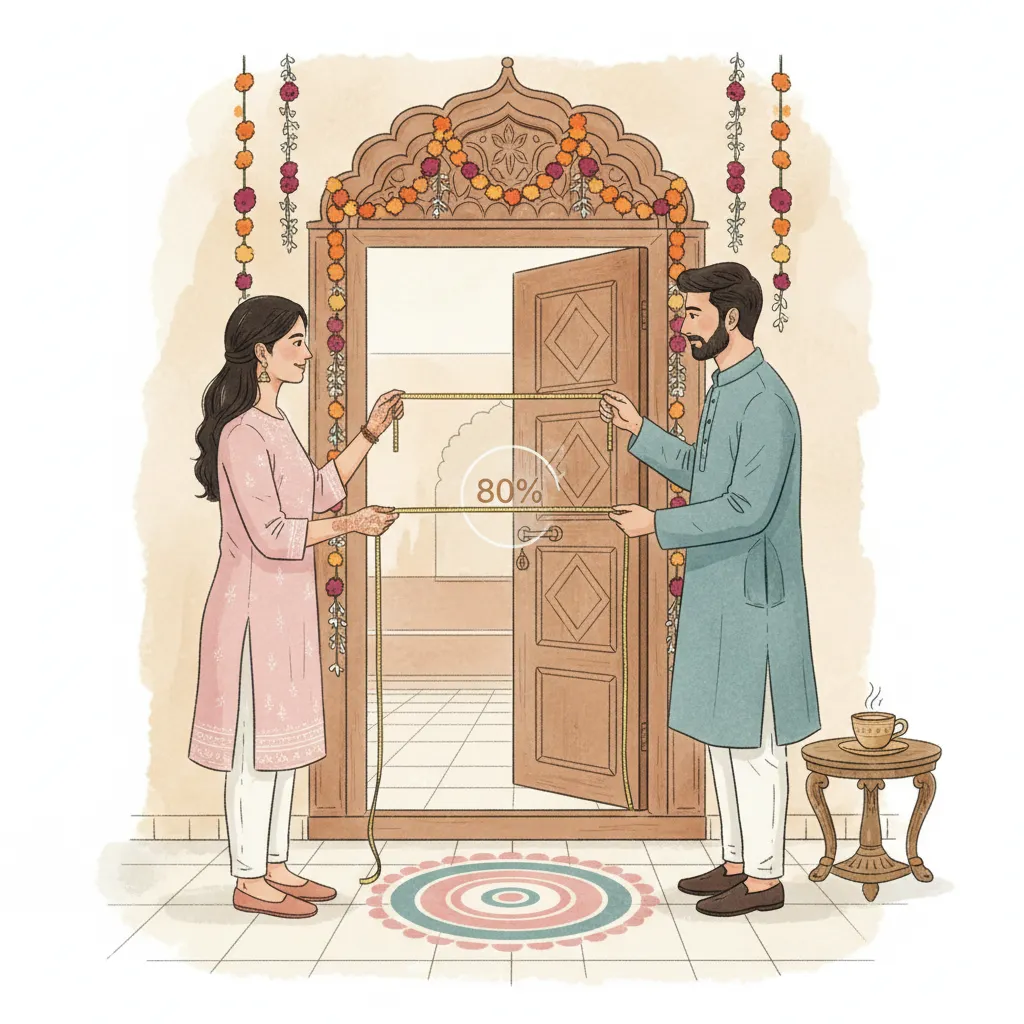
Understanding that 100% is a myth is the first step. The next, and perhaps most crucial, is discerning what truly matters. This is where the 80/20 rule comes into play: identify the non-negotiable 80% that forms the bedrock of a fulfilling partnership, and be willing to flex on the remaining 20% that are often peripheral preferences.
The 80% to Insist On (Non-Negotiables)
These are the foundational pillars that allow a relationship to thrive through life's inevitable ups and downs, especially within the complex dynamics of an Indian family structure.
- Shared Values and Principles: This is paramount. Do you both value honesty, integrity, respect for elders, community service, gender equality, and financial prudence? A shared moral compass ensures you're broadly aligned on how to live your lives and raise a family. For instance, if one partner believes in strict traditional gender roles for household duties and the other advocates for equitable sharing, fundamental conflicts will arise.
- Kindness and Empathy: Observe how they treat those who cannot do anything for them – service staff, children, the elderly, or even animals. Do they speak respectfully to the waiter? Do they show compassion? A kind, empathetic partner will treat you, your family, and others with dignity, even when stressed. This quality is crucial for navigating joint-family living, where daily interactions require understanding and patience.
- Effective Communication and Conflict Resolution: Platitudes about "communication is key" are common, but what does it actually mean? It means a willingness to discuss difficult topics, active listening without interrupting or judging, the ability to express needs respectfully, and a commitment to resolving disagreements constructively. Do they shut down? Do they yell? Or do they try to understand your perspective and seek solutions? In the Indian arranged-match scenario, where you might not have years of dating, actively observe their responses during initial difficult conversations, even if hypothetical.
- Alignment on Life Goals and Ambition: This isn't about having identical careers, but a shared understanding of life's trajectory. Do both partners aspire to stability, personal growth, and perhaps raising a family? Is there a mutual respect for each other's professional aspirations? If one envisions a simple life in a village while the other dreams of an international career, there needs to be a willingness to find common ground. This includes perspectives on financial planning – not just income, but how to save, spend, and invest.
- Respect for Family and Boundaries: In India, marriage is a union of families. Your partner must show respect for your family, just as you respect theirs. Crucially, they must also understand and respect healthy boundaries – both personal and familial. Do they understand when to involve family and when to handle matters privately? Do they allow you autonomy while still valuing family input? This is essential for preventing friction in a joint household or even maintaining harmony between two separate families.
The 20% to Flex On (Peripheral Preferences)
These are often the "nice-to-haves" that, while initially attractive, rarely determine the long-term success or happiness of a marriage.
- Physical Appearance (Height, Weight, Exact Complexion): While initial attraction is important, deep connection rarely hinges on a few inches of height, a specific skin tone, or an exact body type. These are often culturally imposed preferences that have little bearing on a person's character or suitability as a partner.
- Hobbies and Interests: You don't need to share every hobby. Independent interests can enrich your lives and give you personal space. A partner who supports your passions, even if they don't share them, is far more valuable than someone who mirrors all your hobbies but lacks the 80% qualities.
- Exact Career Path or Salary Figure: While financial stability is part of the 80%, obsessing over a precise IIT/IIM background, a specific company, or a target income (e.g., "must earn above 20 lakhs per annum") can blind you to individuals with immense potential, strong work ethic, and excellent character. Growth potential, financial prudence, and a responsible approach to work are more critical than an initial pay slip.
- Mother Tongue or Exact Regional Background (within reason): While a shared cultural context can be comforting, minor differences in regional background or mother tongue are often surmountable if core values align. Families often emphasize these, but if respect and willingness to learn exist, these differences can be a source of richness.
- Specific Social Circles: You don't need to have overlapping friend groups. A partner who encourages your friendships and introduces you to theirs, while also enjoying time with you, is ideal.
Imagine a 30-year-old woman in Pune, an independent professional, whose family is keen on finding her a match from their own community. She meets a man through a family contact. He's slightly shorter than her preference (a 20% flex point) and from a different sub-community. However, in their conversations, he consistently demonstrates genuine respect for her career ambitions, actively listens without judgment, expresses a desire for an equal partnership, and shows genuine empathy when discussing social issues (hitting all the 80% non-negotiables). If she focuses on his kindness, communication, and shared vision for a respectful household, she is likely making a far wiser choice than if she were to dismiss him purely based on his height or sub-community.
Examples of Marriages That Lasted on the Right 80 and Broke on the Wrong 20
Real-life marriages provide the clearest evidence of how these choices play out. The stories below, drawn from common matrimonial experiences, illustrate the power of prioritizing core compatibility over superficial alignment.
Marriages That Lasted (Flexed on the 20, Insisted on the 80)
Scenario 1: The Trekker and The Reader (Bengaluru) A couple in Bengaluru, Anjali and Ravi, were introduced through their families. Ravi was an avid trekker and adventure sports enthusiast, dreaming of Himalayan expeditions every year. Anjali, by contrast, preferred quiet evenings with a book and was happiest exploring historical sites. Their hobbies were a clear 20% mismatch. Ravi's family was initially concerned she might not "keep up" with his adventurous spirit. However, during their courtship, Ravi observed that Anjali possessed incredible empathy, meticulously managed her finances (a trait he admired), and had an uncanny ability to calmly resolve family disagreements – a testament to her strong communication skills and values (all part of the 80%). Anjali, in turn, found Ravi to be incredibly kind, supportive of her career, and genuinely respectful of her desire for intellectual pursuits. They decided to marry, flexing on their differing hobbies. Years later, their marriage thrives. Ravi continues his treks, sometimes with friends, sometimes taking Anjali to simpler, more accessible trails. Anjali maintains her reading clubs and history tours, often recounting interesting facts to Ravi. Their shared 80% – kindness, mutual respect, open communication, and shared financial goals – allowed them to build a strong, supportive partnership, where individual interests flourished rather than caused friction. They understood that love wasn't about identical interests, but about shared values and unwavering support.
Scenario 2: The Joint Family Adjustment (Chennai & Mumbai) Priya, a woman from Chennai, moved into a large joint family in Mumbai after her arranged marriage to Ashok. Her parents had initially hoped for a partner with a significantly higher income (a 20% preference) but were impressed by Ashok's respectful demeanor and his family's strong values. Life in a joint family was a significant adjustment for Priya. There were constant demands on her time, cultural differences, and frequent family gatherings. Ashok, however, proved to be an unwavering pillar of support. He consistently ensured her opinions were heard, gently navigated difficult conversations with his elders, and always presented a united front with Priya, demonstrating his respect and partnership (the crucial 80%). When financial challenges arose, he was transparent, consulted her on every decision, and worked diligently to improve their situation. Their marriage endured and strengthened, not because Ashok matched an initial salary expectation, but because he consistently embodied kindness, open communication, respect for her and her family, and a shared commitment to building a harmonious life together. The initial financial '20%' concern became irrelevant as their 80% foundation proved robust.
Marriages That Broke (Insisted on the 20, Ignored the 80)
Scenario 1: The Socially Perfect Pair (Delhi) Ankit and Neha, based in Delhi, were considered a "perfect match" by their social circles. Both hailed from prominent, well-connected families, had similar high-profile careers in corporate law, shared an elite social circle, and frequently vacationed in the same international destinations (ticking all the superficial 20% boxes). They looked great together on paper and in photographs. However, beneath the polished surface, their 80% was crumbling. Ankit was perpetually dismissive of Neha's opinions, often making sarcastic remarks about her intellect in front of friends and family. He refused to engage in serious discussions about their future, resorting to silent treatment or anger when confronted with disagreements. His empathy was limited, and he frequently prioritised his social standing over their emotional well-being. Neha, in turn, struggled to communicate her needs, often withdrawing and bottling up her frustrations. Despite having every superficial advantage, their marriage dissolved within two years. Their high social status and shared hobbies meant nothing in the face of a fundamental lack of respect, kindness, and abysmal communication. They insisted on the "perfect image" (20%) but neglected the very fabric of a healthy relationship (80%).
Scenario 2: The Lure of Material Wealth (Bengaluru) Deepika, a successful professional in Bengaluru, insisted her partner earn "at least 30 lakhs per annum" and come from a family with significant property, prioritising visible wealth and status (a strong 20% fixation). She found Sumeet, who met these criteria perfectly. He drove a luxury car, had a well-paying job, and his family owned several properties. Initially, Deepika was delighted. However, soon after marriage, she discovered Sumeet was fiscally irresponsible, frequently borrowing large sums from her for dubious investments and delaying repayments. He also showed profound disrespect towards her parents, subtly hinting at their 'sthridhan' and seeing them as sources of future financial benefit rather than cherished family. His communication was manipulative, often guilt-tripping her rather than engaging in honest dialogue. Deepika realised her mistake when the "dream lifestyle" she envisioned turned into financial stress and emotional abuse. Her initial focus on the 20% (material wealth) had blinded her to a critical failure in the 80% (financial prudence, respect, kindness, and honest communication). The marriage ended, leaving her with significant emotional and financial recovery ahead.
Patterns to Recognise
- Positive Indicators (for 80% strengths):
- Active Listening: They genuinely listen to understand your perspective, even if they disagree.
- Consistent Kindness: They treat you, their family, and strangers with a baseline level of respect and consideration, even when stressed.
- Emotional Maturity: They take responsibility for their actions, apologise sincerely when wrong, and don't resort to blame games.
- Value Alignment: Their actions and words demonstrate integrity, honesty, and a shared moral compass.
- Supportive Posture: They demonstrate a willingness to support your goals and stand by you in challenging situations.
- Red Flags (for 80% issues):
- Dismissiveness: They frequently brush off your feelings or opinions, making you feel unheard.
- Disrespectful Behaviour: They display a lack of respect for elders, service staff, or even you, particularly in private.
- Avoidance or Aggression in Conflict: They either shut down, give the silent treatment, or become aggressive during disagreements, rather than engaging constructively.
- Inconsistent Values: Their words don't align with their actions; they might preach integrity but act opportunistically.
- Excessive Focus on Status/Wealth: Their conversations consistently revolve around material possessions, social standing, or comparing incomes.
What to Actually Do This Week
This week, take a moment for reflection. Grab a pen and paper, and honestly answer these questions:
- List Your 80% Non-Negotiables: What are the 3-5 absolute, core values, character traits, and communication styles you must have in a life partner? Think about what you need for daily happiness and navigating life's challenges. Be specific. For instance, instead of "good communication," write "Listens without interrupting, willing to discuss disagreements calmly."
- List Your 20% Flexibles: What are the 3-5 preferences you've held onto that you could genuinely consider relaxing? This might be a specific height, a particular income bracket, a community-specific requirement, or shared hobbies.
- Practice Observation: In your next match meeting, consciously shift your focus. Instead of checking off superficial boxes, spend 80% of your energy observing their kindness, how they communicate, their values, and their respect for others. Ask open-ended questions that reveal these deeper traits. For example, instead of asking "What are your hobbies?", try "How do you handle difficult situations?" or "What's most important to you in a family?"
Focus your energy on discerning character, shared values, and compassionate communication, for these are the true pillars that weather life's inevitable storms, far more than any superficial match.