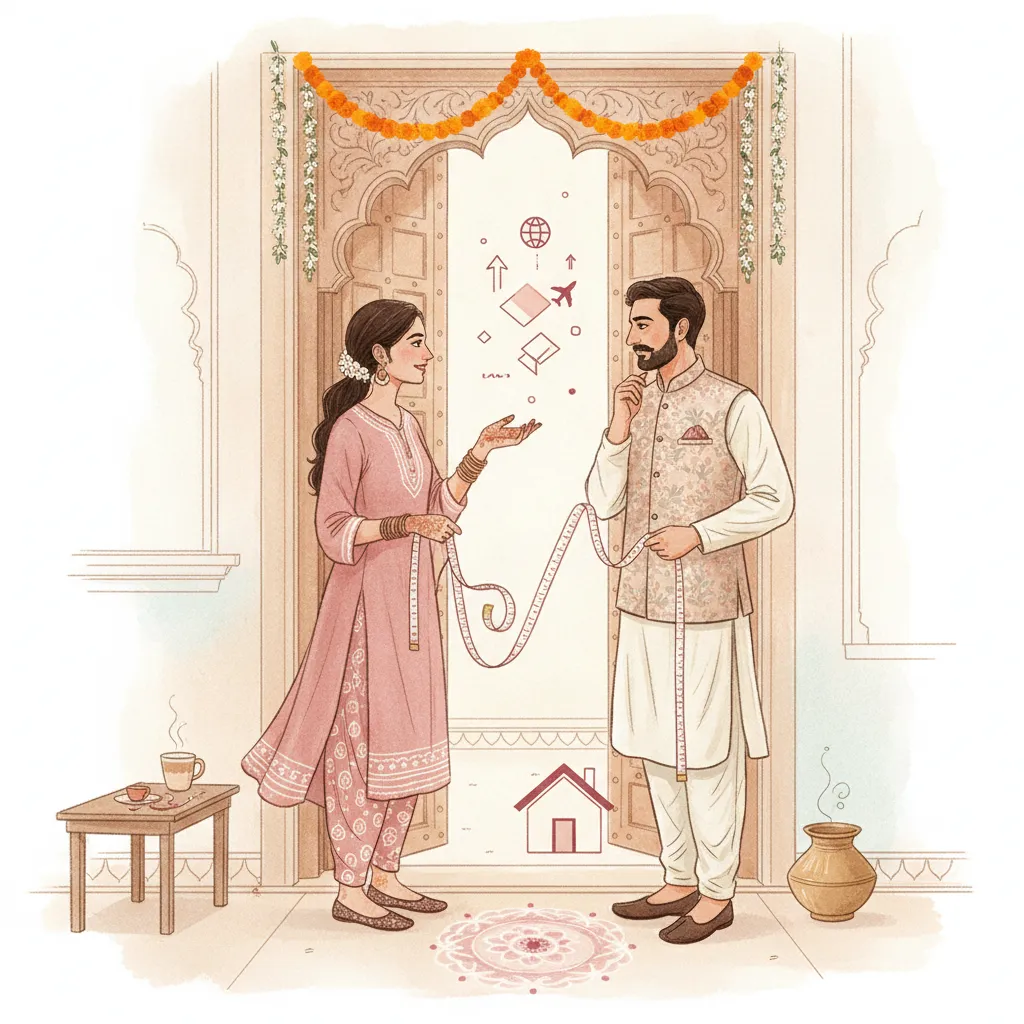
Navigating the path to marriage can feel like trying to read a map in a speeding car. You meet someone promising, the conversations flow, and almost immediately, the pressure mounts from family and society to make a lifelong decision. But what if you had a better map? What if you understood the predictable, natural stages that every healthy relationship moves through?
After reading this article, you will have that map. You will be able to identify which stage your relationship is in, understand what you should be learning at that point, and recognise why the conventional three-month timeline for an arranged match is one of the riskiest bets you can make. This is not about finding fault; it's about building the clarity and confidence to choose a partner for a lifetime, not just for a wedding day.
The Four Stages: A Timeline from First Meeting to Lifelong Partnership
Think of a relationship not as a single event, but as a journey through four distinct seasons. Each season has its own weather, its own challenges, and its own purpose. Rushing through them means you might arrive at your destination unprepared for the climate. While the timelines are approximate, the sequence is a deeply human pattern.
Stage 1: Limerence (The First ~4 Months)
What It Is: This is the intoxicating, rose-tinted phase of initial attraction. It's driven by novelty and possibility. You are both on your best behaviour, presenting the most polished, charming, and agreeable versions of yourselves. You focus on similarities—"You love trekking in the Himalayas too? Me too!"—and subconsciously minimise differences. This is the "highlight reel" stage, and it feels wonderful.
What to Expect: Endless phone calls, excitement before every meeting, and a feeling that you have finally found "the one." Conversations are often about dreams, hobbies, and the best parts of your lives. There is very little, if any, conflict.
What to Observe: While enjoying the feeling, your job here is to be a curious journalist, not a judge.
- Consistency: Are the stories they tell about their work, family, and past consistent over time?
- Behaviour in Public: How do they treat waiters, drivers, and service staff? Courtesy to strangers is a powerful indicator of character when they think no one important is watching.
- Their "Normal": Listen to how they talk about their family, friends, and colleagues. Is it with respect and warmth, or with constant complaint and criticism? This reveals their baseline attitude towards relationships.
The Single Biggest Mistake: Making a permanent decision here. The traditional arranged marriage timeline often forces a Roka or a full engagement within this stage. This is structurally dangerous. You are not committing to the person; you are committing to their representative—the carefully curated, best-behaviour version of them. A decision made in the Limerence stage is based on incomplete and biased data.
Scenario: Imagine a 28-year-old woman in Bengaluru, a graphic designer, meets a 31-year-old man in finance through a matrimonial platform. Their first few meetings are perfect. They have a shared love for independent cinema and continental food. He is charming, well-spoken, and compliments her work. Their families meet and get along splendidly. After two months, the pressure from both sides to fix a wedding date is immense. It feels right, but she has only seen him in two scenarios: a quiet coffee shop and a formal family dinner. She hasn't seen him stressed, tired, or disappointed. She is being asked to sign a lifelong contract after reading only the first chapter.
Stage 2: Bonding (Roughly 4–8 Months)
What It Is: As the initial intensity of Limerence naturally subsides, a deeper, quieter connection starts to form. This is the stage of attachment. You move from presenting your best self to revealing your real self. Vulnerability begins to peek through. You might share a story about a past failure, a current anxiety, or a family difficulty.
What to Expect: A shift from constant excitement to a sense of comfort and familiarity. You might not talk for hours every single night, but the connection feels more stable. The first, minor disagreements may surface, like a difference of opinion on a political issue or how to spend a weekend.
What to Observe: This stage is all about reciprocity and reaction.
- Receiving Vulnerability: When you share something personal that isn't flattering, how do they react? Do they listen with empathy, ask thoughtful questions, and create a safe space? Or do they seem dismissive, uncomfortable, or judgmental?
- Giving Vulnerability: Do they ever let their own mask slip? Can they admit to being wrong about something small, or talk about a time they felt unsure of themselves? A person who is never vulnerable is a person who is still performing.
- Minor Conflict Resolution: When a small disagreement occurs, what happens next? Is there a respectful discussion, or does it escalate into a bigger issue? Do they shut down and give you the silent treatment? The way you navigate a small pothole says a lot about how you'll handle a giant sinkhole later.
The Single Biggest Mistake: Rationalising away small oddities. You might notice they are consistently late, a bit sharp with their mother on the phone, or evasive when you ask about their finances. The temptation is to think, "It's a minor flaw" or "He/She is just stressed." These are not flaws to be ignored; they are data points. This is the stage where the first cracks in the "perfect" persona appear. Your job is to notice them without judgment, but to notice them nonetheless.
Stage 3: Testing (Roughly 8–15 Months)
What It Is: This is the most critical, most uncomfortable, and most-often-skipped stage in an accelerated matrimonial search. This is where the beautiful, polished avatars you both created in Stage One are put away, and the real, complex, flawed human beings show up. Real life intervenes. Stress, fatigue, family obligations, and financial pressures reveal who a person truly is when things are not easy. This stage isn't about deliberately creating tests; it's about paying close attention when life naturally provides them.
What to Expect: Real arguments. Disagreements that don't get resolved in five minutes. You will see their anger, their disappointment, and their coping mechanisms. You might question the relationship. This is normal. This stage is not a sign that the relationship is failing; it's a sign that it is becoming real.
What to Observe: This is where you gather the most important information for your decision. You must see them in situations of mild-to-moderate stress. A person's character is not defined by how they act on a good day; it's defined by how they act on a bad day.
Patterns to recognise in the Testing Stage:
- Under Pressure: How do they behave when they are sleep-deprived, sick, or facing a tight deadline at work? Do they become irritable, blaming, and short-tempered with you, or do they communicate their stress and ask for space or support?
- Family Dynamics: Observe them during a long, chaotic family function—a wedding, a festival, or a pooja. How do they interact with their own family? Are they patient with demanding elders and playful with young children? How do they treat your family when the formal facade drops?
- Financial Stress: Discuss a hypothetical financial setback. For example, "What would we do if one of us lost our job for six months?" or "How would we handle an unexpected medical expense of two lakh rupees?" Their response will reveal their attitude towards money: are they a partner, a provider, a controller, or a panicker?
- Disappointment: Plan something together that gets cancelled or goes wrong—a trip, a dinner reservation. Watch their reaction. Do they adapt and make the best of it, or do they sulk, blame, and let it ruin the entire day?
- Accountability: During a serious disagreement, can they ever say, "You're right, I was wrong about that. I'm sorry"? Or do they always need to win the argument, deflecting blame and rewriting history?
A Note on Safety: If disagreements in this stage involve attempts to control you (demanding passwords, telling you who you can or cannot see), insults, or threats, these are not "tests"—they are serious red flags. If you feel the need to address this behaviour, please confide in a trusted friend or family member first. Leaving a controlling relationship can be a high-risk time, and you deserve support.
The Single Biggest Mistake: Skipping this stage entirely. This is the default outcome of a 3-to-4-month courtship. You go from the Limerence highlight reel directly to a legally binding Commitment. You are marrying the person you met, not the person you know. You have no data on how they handle adversity, and adversity is a guaranteed part of life.
Scenario: A couple in Pune, both in their early 30s, have been seeing each other for ten months. They decide to assemble a complex piece of flat-pack furniture together on a Sunday. The instructions are confusing, a piece is missing, and they are both getting tired and hungry. One person becomes increasingly frustrated, snapping that the other isn't helping properly. The other feels attacked and shuts down. The argument that follows isn't about the wardrobe. It's about their fundamental styles of coping with frustration, communication under stress, and teamwork when things go wrong. Resolving this successfully is a far better predictor of marital success than a dozen perfect restaurant dates.
Stage 4: Commitment (Roughly 15+ Months)
What It Is: This stage is not a feeling; it is a conscious, informed choice. You have seen each other at your best (Stage 1), you have built a genuine connection (Stage 2), and you have weathered challenges together (Stage 3). You have seen their flaws, their weaknesses, and their difficult side. You know they are not perfect. Commitment is looking at this complete, unvarnished picture of a person and saying, "Yes. I choose you. I choose this."
What to Expect: A sense of peace and security. The relationship is no longer a source of anxiety or constant questioning. The focus shifts from "Are we right for each other?" to "How do we build our life together?" Conversations become deeply practical: joint finances, expectations around living with in-laws, parenting philosophies, and supporting each other's career goals.
What to Observe: At this point, observation turns into collaboration.
- Teamwork: When faced with a decision, is the default mode "you vs. me" or "us vs. the problem"?
- Shared Vision: Are you both excited and aligned on what the next 5, 10, and 20 years could look like? You don't need to agree on every detail, but the fundamental values should match.
- Active Choice: Do you both feel you are actively and enthusiastically choosing this partnership, or does it feel like you are passively sliding into marriage because of inertia or family pressure?
The Single Biggest Mistake: Assuming that Commitment means the work is over. A marriage certificate is not a finish line; it's the start of a new, lifelong marathon. The skills of communication, empathy, and problem-solving that you built during the Testing stage are the very skills you will need for the next fifty years. Another mistake is to yearn for the constant high of the Limerence stage. Mature love is a calmer, stronger, and deeper emotion.
A Practical Guide: The Power of an Extra Six Months
The single, highest-return investment you can make in your future happiness is to deliberately stretch the timeline before finalising your marriage. The goal is not to delay for the sake of delaying; it's to give your relationship enough time to naturally progress through the Limerence and Bonding stages and into the all-important Testing stage.
When family pressure mounts, you don't have to be rebellious. You can be mature and strategic. Instead of saying "I'm not sure," which can cause panic, try framing it as a sign of seriousness:
"We feel a very strong connection and are very serious about this. Because we want to build a foundation that lasts a lifetime, we have both agreed that taking another six to nine months to get to know each other across different situations is the wisest thing to do before we talk about wedding dates. We want to do this properly."
This reframes the delay from a sign of doubt into a sign of wisdom and mutual respect—something most parents can understand and appreciate.
Ask Yourself This Week
- Looking at the four stages, honestly, where are you right now with the person you are considering?
- What is one real-world situation you can experience together this month that isn't a curated "date"? (e.g., grocery shopping for a family dinner, helping a friend move, volunteering for a local cause for a day). The goal is to observe each other in a context that involves minor chores, stress, or teamwork.
A quick note on verification: At TrueSoulMatch, our verification process confirms that a person's government ID and photos match, which is a crucial first step in confirming identity. But it cannot verify character, temperament, or financial history. That is the work you must do, and that work takes time.
Choosing a life partner is the most significant decision you will ever make. It is not a race. Give yourself the gift of time to move beyond the highlight reel and see the full, true, and complex person you are choosing to build a life with. Making an informed choice is the ultimate act of love for both yourself and your future partner.