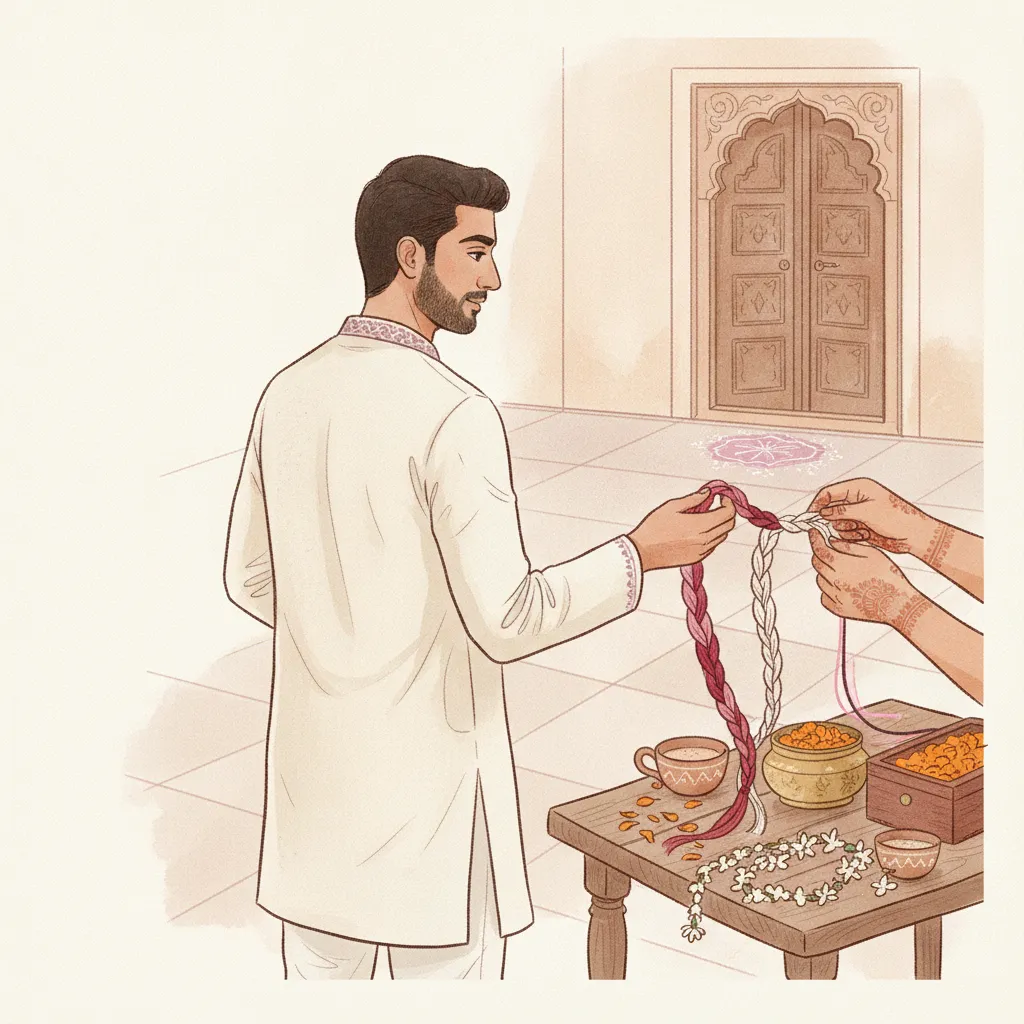
Imagine a couple, five years married. On a Sunday afternoon, they are sitting on their balcony, drinking tea. His mother calls. He answers, chats for ten minutes about a cousin’s engagement, and hangs up. He turns to his wife and says, “Mummy was asking if we’re coming for Diwali.” She nods. “Let’s talk about it tonight. I might have that big project deadline right then.” The conversation is easy. There is no tension, no hidden transcript, no report being delivered back to headquarters. Their life is their own, and their families are a cherished, respected part of it—orbiting the centre, not occupying it.
This is not the result of a "love marriage" or an "arranged marriage." It is the result of a deliberate marriage. It’s the outcome of two people who understood, from their very first conversations, that they were not just choosing a partner. They were designing a partnership, with and sometimes despite the families who loved them most.
The debate between arranged and love is a ghost. The vast majority of us now live in the middle, in a space we might call “family-introduced, self-decided.” Your family provides the introduction; you provide the discernment. They offer their network and experience; you reserve the final, non-negotiable vote. This is the new landscape, and it requires a new set of skills—not for finding a person, but for forging a couple amidst the loving, anxious, and sometimes overwhelming presence of family.
The Alliance You Build Before the Wedding
The first test of your partnership is not how you handle your first fight or your first financial decision. It’s how you handle the process of deciding. This period, whether it’s six weeks or six months, is a miniature version of your married life. The pressures are the same—competing loyalties, the flow of information, the management of expectations. How you and a potential partner navigate this together is the most reliable preview of the next thirty years.
The goal isn't to push your family away. It’s to gently, firmly establish the primary alliance with the person you are considering marrying. This alliance is built in the small moments.
Consider Sameer, a 28-year-old civil engineer from Nashik. His father, eager to see him settled, is overwhelmingly helpful. Before every meeting with Rina, a potential match, his father hands him his credit card. “Don’t worry about the cost, beta. Just have a nice time. Make a good impression.” It feels like support. But let’s look at the ledger.
- Week 1: Coffee at a nice café. ₹1,500.
- Week 2: Dinner at a popular Italian restaurant. ₹4,000.
- Week 3: A movie and another meal. ₹2,500.
After three weeks and ₹8,000 of his father’s money, the question comes. “So, she seems lovely. We’ve invested a bit in this now, haven’t we? When are we meeting her parents to take things forward?” The money was never just money. It was the purchase of a stakeholder’s vote in the timeline. It wasn't malicious; it was a father’s strategy, born of love and anxiety, to keep the process moving. Sameer’s ability to see this, and to say, “Dad, I appreciate the help, but I’m going to pay for this myself from now on so Rina and I can figure things out at our own pace,” is his first act as a partner, not just a son. He is drawing the boundary of the new family unit before it even officially exists.
The Pressure That Wears a Helpful Disguise
Well-intentioned families exert influence. It is their nature. The skill to learn is distinguishing between support that empowers your decision and "help" that directs it. This often comes down to observing not the grand gestures, but the subtle, repeated patterns of communication.
The Information Funnel
One of the most common dynamics is the family member who becomes the unofficial project manager of your search. They want daily updates. They ask for detailed readouts of your conversations.
This is where you must learn to read the mechanism, not just the motive. The motive is almost always love. The mechanism, however, can be corrosive. When you report every detail of a budding relationship to a third party, that relationship ceases to be your own. You begin subconsciously curating what you say to your potential partner, already thinking about how you’ll frame it for your parents. The private space where two people build rapport and vulnerability is punctured.
Let’s trace this forward. Aarav, a 27-year-old in Indore, tells his mother everything about his first few calls with Priya. In the beginning, it feels harmless.
- Month 1: He gives his mother a summary of their conversations. “We talked about our hobbies. She likes to read.”
- Month 6 (if they were married): His mother, now accustomed to being an insider, asks, “Priya seemed quiet on the phone today. Is everything okay with her project at work?” She expects to be briefed on her daughter-in-law's moods and professional stresses. Aarav is now the permanent go-between.
- Year 3: They are making their first big investment. His mother says, “I hope you’ve thought this through. Priya can be a bit impulsive with money.” She feels entitled to have this opinion and to voice it directly, because the precedent was set years ago: this marriage is a transparent system, and she has an all-access pass.
The counter-move is not a confrontation. It is a gentle re-framing, delivered early and consistently.
Mother: "So? What did you two talk about for an hour? Did you ask her about her plans to work after marriage?"
Aarav: "We had a really nice chat, Mummy. We’re still just getting to know each other. I’ll definitely let you know when there’s anything real to share."
Mother: "I'm only trying to help. These things are important."
Aarav: "I know, and I really appreciate it. The best help right now is giving us the space to figure it out ourselves. It lets me see who she is without any pressure."
This response validates her intention while setting a boundary on the behaviour. It teaches your family, calmly, that the couple's conversations are a black box. They will be informed of the outputs (e.g., "we've decided to meet again"), not the internal processing.
The Premature Integration
Another common pattern is when the other family tries to absorb you before a commitment is made. It feels flattering. His mother adds you to the family WhatsApp group after the second meeting. Her father calls you to discuss your career path.
One of the most powerful probes is the direct call from a potential mother-in-law to a potential daughter-in-law. Anjali, a 26-year-old teacher in Patna, met a man named Vishal. Two days after their first family meeting, his mother called her. The call was warm, full of praise for Anjali. Then came the questions. Not about her, but about her function. Would she be able to manage the household with her teaching schedule? Were they planning to live in a joint family setup? Did she plan on having children in the first couple of years?
The effect of this move is to bypass the connection between Anjali and Vishal entirely. It reframes the purpose of the marriage from a relationship between two people to Anjali’s integration into a pre-existing family system. It tests her deference and her willingness to discuss her life's blueprint with them before she’s even decided if she likes their son. The genders in this scene are illustrative; the dynamic would be identical if a prospective father-in-law called the man to ask for his five-year financial plan and his views on supporting his wife's parents.
The innocent version of this is a simple, warm text: “It was so lovely to meet you, Anjali. Hope to see you again soon.” It expresses warmth without demanding information or intimacy. The concerning version is the one that seeks to qualify you for a role.
A calm, boundary-setting response might be: “Aunty, it’s so kind of you to call. I really enjoyed meeting everyone. Vishal and I are still in the very early stages of getting to know each other. I think those are important questions, and they’re things he and I should probably discuss first, once we know where this is going.” This is polite, respectful, and pulls the focus back to the primary dyad: you and the person you might marry. How the mother—and, more importantly, how Vishal—reacts to this tells you everything. Does he call you, annoyed that you “offended” his mother? Or does he call you and say, “I’m sorry, my mum can be a bit much. You handled that perfectly”? His response reveals his allegiance.
The Blueprint for Your Partnership
You do not have to pick a pre-written script titled "arranged" or "love." You get to write your own. This process of designing your courtship is your first act of co-creation. It’s a project you undertake with your potential partner, with your families as valued consultants, not executive directors.
Here are the conversations that build the foundation for that future Sunday afternoon on the balcony.
-
Establish the Private Channel. Agree early with your potential partner: "Let's make a deal. We talk to each other about things first. Before we talk to anyone else." This creates a container of trust. It ensures that when you face a problem, your first instinct is to turn toward each other, not outward to your parents.
-
Synchronize Your Updates. Instead of separate debriefs, decide together what you’ll share with your families and when. Saying, "We've decided we’d like to meet a few more times on our own," is a statement from a unified ‘we’. It’s much harder to argue with than one person’s hesitant "I think I need more time." This practice demonstrates to both families that you are a team in formation.
-
Define “Helpful” Out Loud. Your parents aren’t mind-readers. They are operating from a script of love and duty they’ve known their whole lives. It falls to you to give them a new script. Have a direct conversation: "Mummy, Papa, I know you want the best for me. Right now, what would be most helpful is your trust in my judgment and the space for me to make this decision. When I need your advice on [a specific thing, like evaluating a family's reputation or financial stability], you will be the first people I ask."
-
Negotiate the Timeline Together. The single greatest source of tension is pace. Families often want to move from introduction to engagement in a matter of weeks. You need seasons, not days. Talk about this with your match. Agreeing on a timeline—"Let’s give this at least three months of regular conversation before we even talk about the next step"—is a powerful act. It aligns your expectations and gives you a shared answer when the pressure mounts. It shows you can collaborate on something as fundamental as time itself. And for anyone feeling unsure about how to even begin these conversations, knowing you have a First-Timer's Advantage: Navigating Partner Choice Without Past Dating Experience can provide a useful framework.
The Two Costs You Must Weigh
There is a risk to drawing these lines. You might set a boundary with a perfectly good person whose family operates on a different, more enmeshed model, and they might walk away. You might lose a potential match because you refused to move at their family’s pace, or because you insisted on privacy. This is a real cost, and pretending it doesn't exist is dishonest.
But you must weigh it against the other cost: the cost of not drawing the line. The cost is a marriage where you are never fully adults. A life where your partner’s primary loyalty is to their parents, not to you. A relationship where every major decision is put to a committee vote and your home is never quite your own. That cost is paid out over decades, in quiet resentments and a slow erosion of intimacy.
The process of choosing a partner is also the process of choosing a life. The small negotiations you have today about who gets told what, how quickly you move, and whose opinion matters most are not obstacles to the main event. They are the main event. How you and a potential partner handle this first, delicate collaboration will tell you almost everything you need to know about the quality of the silence, the ease of the conversation, and the peace of the home you will build together.