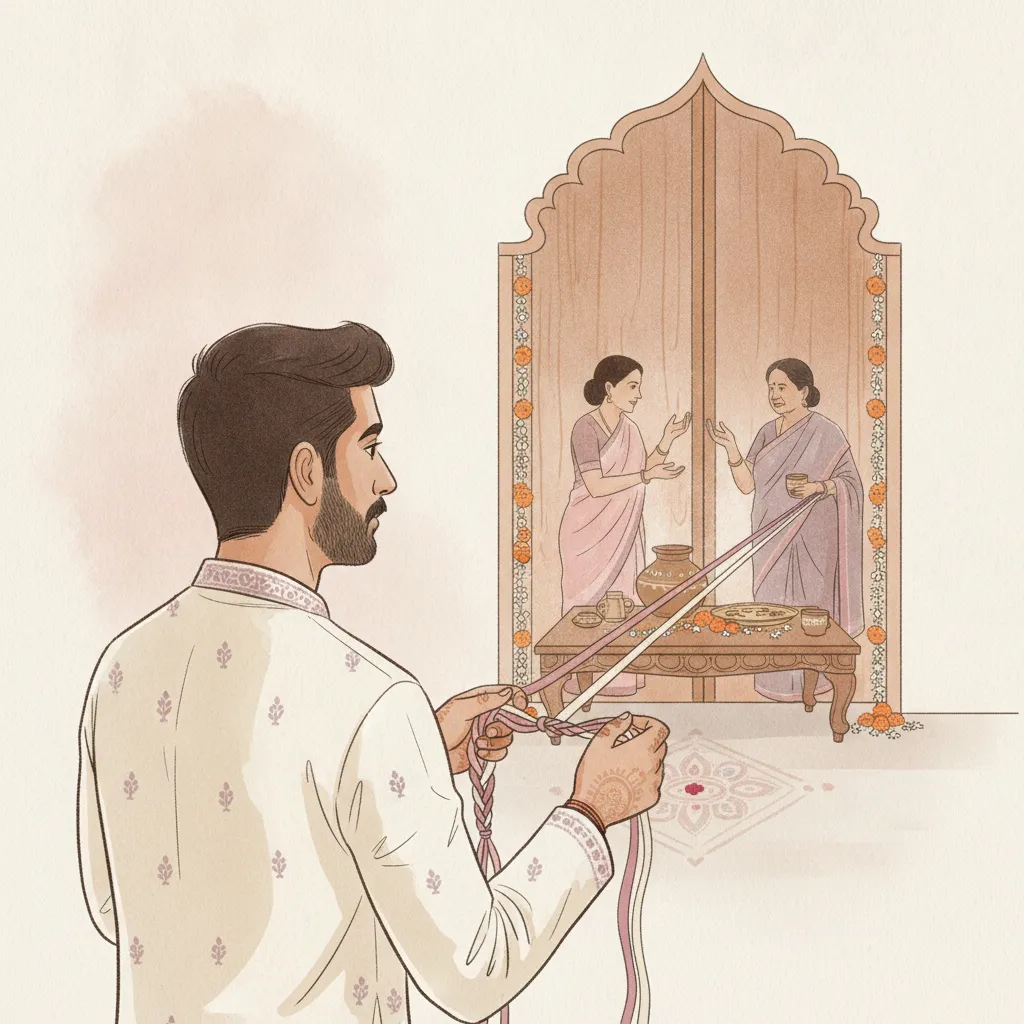
Let's be honest about a fear that haunts the Indian matrimonial search. It’s the quiet, nagging question you ask yourself after a promising meeting or a pleasant phone call: Do they like me, or do they like what I have?
We need to kill a stubborn stereotype right here. The image of the gold-digger, the financial exploiter in a marriage, is not exclusively female. And the victim is not always a man. Financial extraction is an equal-opportunity problem that wears two very common faces in our culture.
There is the groom’s side that views the bride’s family as an unending source of funds — starting with "expectations" for the wedding, which are really just dowry in polite language, and extending to a lifetime of subsidising a lifestyle they feel entitled to.
And there is the partner, of any gender, who marries for a package deal: the steady salary, the flat in a prime location, the family inheritance, or the coveted NRI status that promises a life abroad. Their affection feels real, but it’s conditional, a lease on your assets that expires the moment the assets are threatened.
Anyone can be the target, and anyone can be the exploiter. The good news is that you don’t have to rely on a vague "gut feeling" to tell the difference. This is not about becoming cynical or suspicious of everyone you meet. It’s about becoming discerning. It's about learning to spot the difference between a partner who wants to build a life with you and one who wants to build a life off you. This guide will give you the concrete tools to do just that.
The Transactional Test: How to Tell Interest from an Invoice
A person whose primary motive is financial is playing a role. They are performing the part of an ideal partner, and like any performance, it has tells. The key is to stop listening only to their words and start observing their patterns. Their interest in you is real, but you need to identify what, exactly, they are interested in. It’s not about a single "gotcha" moment, but a consistent pattern of behaviour.
For example, Meera, a 29-year-old designer in Pune, was speaking with a prospective match, Karan, an engineer from a well-regarded family. The conversations were pleasant, but she noticed a strange pattern. When she talked about her passion for ceramics or her anxieties about her ageing parents, his responses were polite but generic. But the moment she mentioned that she had inherited a small, mortgage-free flat from her grandparents, his energy surged. Suddenly, he was full of questions, not about her memories of her grandparents, but about the square footage, the rental potential, the location. The warmth she craved was there, but it was switched on by talk of assets, not by her actual life.
Patterns to Recognise
Instead of relying on a vibe, look for these observable behaviours. One incident might be a misunderstanding. A consistent pattern is data.
- The Energy Shift. Pay close attention to when they become most animated, engaged, and warm. Does their enthusiasm spike when the conversation turns to your salary, your family’s business, the property you own, or your prospects for an international transfer? A genuine partner is interested in your passions, your fears, and your day-to-day life, not just the highlights from your financial portfolio.
- The Asset Audit Before the Soul Search. In early conversations, a person building a genuine connection wants to know who you are. What makes you laugh? What was your biggest failure? What are your non-negotiable values? A person conducting a transaction wants to know what you have. They will probe your income, savings, investments, and family wealth long before they ask about your character. Their questions sound more like an auditor's checklist than a curious heart's inquiry.
- The Fixation on the "Package". Does the conversation, whether with them or their family, constantly circle back to what you can provide? For men, this often sounds like, "What is your five-year financial plan?" or "How much can you contribute to a joint household?" For women, it can be more insidious, with questions directed at her family: "What are your plans for the wedding?" or "Of course, you will want to ensure your daughter is 'set up' comfortably." The focus is relentlessly on what is being brought to the table, not who is sitting at it.
- The Slow Leak of "Small" Asks. This is a classic pattern. It rarely starts with a huge demand. It begins with a series of "small emergencies" or "temporary loans" framed as a test of love and trust. "My bike broke down, can you help with the repair?" "I have a cashflow issue in my business, could you just cover my rent this one time?" These requests slowly escalate in frequency and amount, creating a dynamic where you become a financial safety net before you’ve even built a true partnership.
- The Financial Fog. A partner who is transparent about their own financial situation—their income, their debts, their goals—is inviting you into a partnership. A partner who is evasive, vague, or defensive about their own money while intensely curious about yours is hiding something. They might offer grandiose stories about future earnings that never seem to materialise or deflect direct questions with phrases like, "Don't worry about it, I have it handled." This one-way transparency is a massive red flag.
The single most powerful diagnostic tool is a thought experiment: "Would they still choose me if the primary financial asset they’re focused on were suddenly off the table?"
You don’t have to ask this directly. You can test it. If you suspect they are after your high salary, you could say, "You know, my long-term dream is actually to leave my corporate job and start a small-scale social enterprise. It would mean a significant pay cut for a few years, but it’s where my heart is."
Now, watch their reaction closely. A true partner might be concerned, but they will be curious. They will ask about your passion, the logistics, how you could make it work together. They will engage with your dream. A transactional partner will panic. You will see the interest drain from their face. Their questions will be about the loss of income, not the pursuit of your dream. Their disappointment will be palpable, because you just threatened the central pillar of their "investment."
Two Sides of the Same Rupee: How Extraction Plays Out
These patterns aren't theoretical. They appear in calm, living-room conversations and seemingly innocent WhatsApp chats every day. The goal is to recognise the script, whether you are a man or a woman.
Scene 1: The Groom's Side and the Ever-Expanding "Gift" List
Priya, a 32-year-old marketing manager in Delhi, and her family were thrilled with the match they’d found in Sameer. He was well-spoken, had a stable job, and the families seemed to get along. The initial meetings were warm. Sameer’s mother had mentioned, almost as an aside, that their family had a "lovely tradition" of the bride's side gifting a car to the groom for his commute. Priya's father, wanting to be generous, mentally budgeted around ₹8 lakh for a decent sedan.
A few weeks later, during a follow-up call, Sameer’s uncle casually remarked that with the state of Delhi traffic, an automatic SUV would be "far more practical and safe for Sameer." The cost of this "suggestion" was closer to ₹14 lakh. Before the roka (engagement ceremony) was even fixed, a new topic emerged: the high cost of real estate. Sameer’s father sighed, "It is so difficult for young people to start out. We are helping Sameer as much as we can with the down payment for a flat, but of course, any support from Priya's side to help the new couple would be a great blessing."
No one ever used the word "dowry." There was no overt demand. It was a masterclass in quiet, upward revision. Each conversation added another layer of expectation, framed not as a condition, but as a loving contribution to the couple’s future. For Priya’s family, the initial excitement was curdling into a sense of being evaluated not on their daughter's merits, but on their capacity to fund the lifestyle Sameer's family expected.
Scene 2: The Charming Partner and the "Business Opportunity"
Arjun, a 34-year-old software architect in Bengaluru, had been speaking to Nisha, 31, for three months. The connection felt electric. She was witty, ambitious, and showered him with affection and compliments. She praised his career, his taste in music, his sense of humour. Arjun, who was often reserved, found himself opening up completely.
One evening, after a particularly heartfelt conversation, Nisha grew serious. She told him about a "once-in-a-lifetime" business opportunity she had—a niche e-commerce venture. She had the entire plan ready, she said, but was short on initial capital. "It's just ₹2 lakh to get the first inventory order in," she explained, her voice full of excitement. "I'd ask my family, but I want this to be mine. And I feel like I can tell you anything. I’ll pay you back as soon as the first big order comes through, I promise."
Arjun, caught up in the intimacy of the moment and wanting to be a supportive partner, transferred the money the next day. But in the weeks that followed, the business details remained vague. When he gently asked to see the business plan or the inventory receipts, Nisha became hurt and defensive. "I can't believe you don't trust me," she said, her voice wounded. "I thought we were building a life together, that we were a team. This feels like you're auditing me." The conversation was shut down, and her affection became a tool to deflect accountability. Arjun was left feeling confused and guilty, realising he hadn't made an investment in a business, but had paid a fee to maintain the affection he had come to value.
Financial Alignment vs. Financial Exploitation: Drawing the Line
Let’s be crystal clear: talking about money is not the red flag. In fact, not talking about money is a bigger one. A healthy, modern marriage requires financial compatibility. Two people honestly and openly aligning on their financial realities is a sign of maturity and a foundation for a strong future.
Financial alignment is good. It sounds like:
- "What are your long-term career and financial goals?"
- "How do you view debt? Are you a saver or a spender?"
- "What are our expectations around supporting our parents as they age?"
- "If we live in a joint family, how will we manage household contributions and individual financial freedom?"
- "Let's be transparent about our current income, assets, and any outstanding loans so we can plan our future together."
This is a two-way conversation between equals. It’s about building a shared map for the future.
Financial exploitation is the red flag. It sounds like:
- "My family expects the wedding to be held at a five-star hotel. You'll handle that, right?"
- "Since you earn more, it’s only fair you cover all the major household expenses."
- "I need you to co-sign this business loan for me." (Before marriage!)
- A one-sided, interrogating focus on your assets, with no matching transparency about theirs.
This is a one-way transaction. It’s about one person viewing the other as a resource to be tapped.
It is also vital to know your rights, not as a weapon, but as a shield. The Indian legal system is clear on two points. First, under the Dowry Prohibition Act, 1961, demanding, giving, or taking dowry is illegal. The subtle, coercive "gift" suggestions are a social loophole for an illegal act. Second, a woman's stridhan is her absolute, individual property. This includes all gifts (movable or immovable) she receives from her own family, her in-laws, or friends before, during, or after the marriage ceremony. It is not household property, and neither her husband nor her in-laws have a legal right to control or dispose of it. Understanding this distinction is crucial.
Protect Your Future, Not Just Your Finances
The goal here is to enter a marriage with your eyes open, not with a heart full of suspicion. Prudence is not paranoia. Taking sensible steps to protect yourself is a sign of self-respect, and a genuinely good partner will understand and even appreciate it. A person with ulterior motives will be the one who objects.
Protecting yourself is about creating the time and space to see the patterns. Financial predators, like all manipulators, thrive on speed and emotion. They want you to get so caught up in the romance or the pressure of a timeline that you don’t stop to ask the practical questions. Your best defence is to slow down.
Ask Yourself This Week
Before you take the next step with anyone, pause and reflect on these questions. Write down the answers if you need to.
- Inventory your conversations: In your last five conversations, what was the ratio of talk about values, dreams, and personal stories versus talk about money, assets, and possessions?
- Run the "No" Test (in your mind or in reality): What is a small, reasonable financial boundary you could set? For example, if they suggest you both invest in something speculative, you could say, "I'm more of a conservative investor, so I'll have to pass on that for now." If they ask for a loan, you can say, "I have a personal policy of not lending money, but I'm happy to help you brainstorm other solutions." How do you predict they would react? With understanding, or with pressure and emotional withdrawal?
- Check for reciprocity: How much do you know about their detailed financial situation compared to how much they know about yours? Is the flow of information balanced?
The most telling sign of a transactional partner is how they react when the transaction is denied. If you say "no" to a premature financial request—whether it's for a loan, a lavish gift, or access to your bank accounts—and the warmth, affection, and attention suddenly vanish, you have your answer. You weren’t connecting with a person; you were negotiating with an agenda.
A genuine partner who is building a life with you will welcome honest conversations about money and respect your boundaries. They will see your prudence as a strength, not an insult. Someone who is leasing your assets will get evasive, offended, or angry when you introduce accountability. They will accuse you of not trusting them, when in reality, they have not yet earned that trust.
Remember that TrueSoulMatch's verification confirms a user’s identity with their government ID—it confirms they are who they say they are. It does not and cannot verify their character, their financial history, or their intentions. That crucial discovery work is, and always will be, yours to do.
Walking away from a promising match because you see these red flags is not a failure. It is a profound act of self-preservation. It is choosing the uncertainty of continuing your search over the certainty of a future built on a transaction. It is holding out for a partner who is interested in the treasure that you are, not just the treasure that you have. And that is a choice, for any man or woman, that is always worth making.