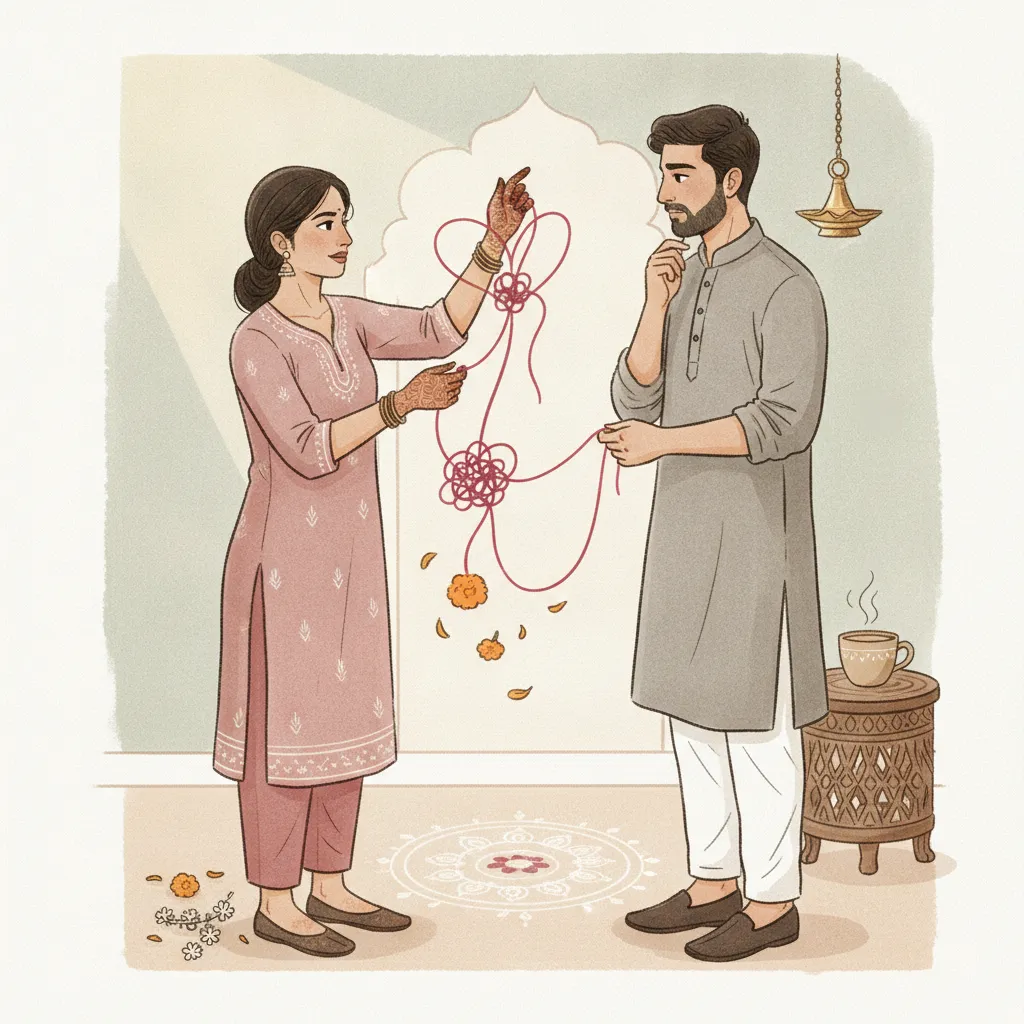
In the search for a life partner, you are building something profound: a future based on trust, mutual respect, and shared values. This journey, especially within the Indian matrimonial context, is often a whirlwind of meetings, family discussions, and powerful emotions. Amid this intensity, your clarity is your greatest asset.
This article is designed to give you a specific tool for that clarity. It will help you recognise a distinct pattern where intense, early affection is used to create a sense of obligation, which is then quietly leveraged for financial gain. This isn't about becoming suspicious of everyone; it's about becoming skilled at discerning a solid foundation from a hollow one. You have good instincts. This is how you sharpen them.
The Pattern: From "Soulmate" to "Sponsor" in Record Time
The beginning of this pattern feels like a dream. In a search process that can sometimes feel transactional, you meet someone who seems to see right into your soul. The connection is immediate, the conversations are deep, and the declarations of affection are swift and sweeping. They don’t just like you; they’ve “never met anyone like you before.” They don’t just see a future; they are already planning the minutiae of your lives together after only a few video calls.
This initial phase is designed to overwhelm your rational mind. In the accelerated timeline of arranged matches, this intensity can be mistaken for certainty. Families might see it as a sign of a decisive and committed match. You might feel a profound sense of relief that the search is finally over.
Then, just as this deep bond feels cemented, the story shifts. A subtle but urgent problem emerges on their side. It is never presented as a straightforward demand for money. Instead, it is framed as a shared problem for "us" to solve, a first test of your partnership.
Imagine a 32-year-old marketing manager in Gurgaon connecting with a man whose profile looks promising. The first few weeks are a blur of flattering, non-stop communication. He praises her intelligence, her ambition, her family values. He talks about how her presence in his life feels like destiny. He sends poetry. He remembers small details from her stories. He makes her feel seen and cherished. Just as she starts telling her parents, "I think this is the one," he calls her in a state of distress. A close family member has had a sudden medical emergency, and he’s short ₹2 lakh for the hospital deposit. He sounds embarrassed, stressing that he would never normally ask, but he feels so close to her, he considers her family already. He says, “I know it’s a lot to ask, but we’re a team, right? I’ll pay you back as soon as my investment matures next month.”
The request is wrapped in the language of love, trust, and partnership. To refuse feels like rejecting the very connection he just spent weeks building.
Patterns to Recognise
This dynamic isn't a single event but a sequence of behaviours. Here is what the pattern looks like when broken down into its component parts:
- Accelerated Intimacy: They claim to feel a unique, "once-in-a-lifetime" connection with you almost immediately. Phrases like "soulmate," "I've been waiting for you my whole life," or "I've never been able to open up to anyone like this" are common after just a handful of conversations.
- Future-Faking: They create elaborate, detailed pictures of your future together. This goes beyond "I'd like to settle down." It sounds more like, "Our children will go to that school near your parents' house," or "I can already picture you doing puja in our home." This builds a fantasy you become emotionally invested in.
- Testing the Waters with Small Talk: Before a large financial request, they may casually mention past financial hardships or current money troubles to gauge your reaction and see how sympathetic you are. They might talk about a "bad business partner" or an "unforeseen expense" that set them back.
- The Urgent, Unverifiable Crisis: The request for money is almost always tied to a sudden, dramatic crisis—a medical emergency, a business deal about to fall through, a problem with customs, or a family crisis that requires immediate cash. The situation is designed to be too urgent for you to perform due diligence or consult others.
- Framing the Ask as a Test of Love: The core of the manipulation is linking the financial transaction to the emotional bond. They don't say, "Give me money." They say, "I need to know I can count on my life partner," or "This will prove to me that you're as serious about us as I am."
The Psychology: Why This Feels So Real and How to See Clearly
This approach is effective because it hijacks the natural human desire for connection and certainty, especially in the high-stakes environment of a matrimonial search. When you're genuinely seeking a lifelong partner, you want to believe you’ve found them. A person who mirrors your hopes, compliments your best qualities, and paints a beautiful picture of the future is telling you exactly what you long to hear.
Genuine generosity in a budding relationship flows from a place of abundance and care, without expectation. A kind person might offer to pay for a meal, bring a thoughtful gift, or help you with a task because it feels natural to them. There are no strings attached.
Affection that comes with an invoice, however, is a transaction disguised as a gift. The "gift" is the intense flattery and emotional validation. The "invoice" arrives later. The key to telling them apart is to understand that the affection was never the real product; it was the marketing for the financial request.
The ultimate test is not what happens when you say yes to their love, but what happens when you say no to their money.
Consider a 29-year-old software engineer in Hyderabad. He connects with a woman who seems perfect—educated, charming, and very appreciative of his stable career. She tells him how secure she feels knowing he’s so responsible. After a few weeks, she mentions a professional certification course that would significantly boost her career, but she’s just short of the funds for the final payment of ₹75,000. She says, “With your support, I could secure my future, which is really our future.”
His instinct might be to help, to show he is a capable and supportive partner. But this is the crucial moment for clarity. The question isn't whether he can afford it. The question is what happens if he sets a boundary.
If he says, “I’m so excited for your career goals, and I’d be happy to help you research educational loans or scholarships. However, I have a personal rule to keep my finances separate before marriage,” her reaction is the only data he needs. A genuine partner might be disappointed but will respect his principle. Someone with a transactional motive will likely become cold, accusatory, or guilt-inducing. The warmth will vanish because its purpose—securing the funds—has been denied.
While TrueSoulMatch's verification process confirms that a person is who their government ID says they are, it cannot verify their financial status, past behaviour, or their character. That part of discovery is yours, and it requires observation over time.
Your Playbook: Slowing the Pace and Holding Your Ground
Recognising the pattern is the first step. Responding with strength and clarity is the next. This doesn’t require confrontation or drama. It requires firm, calm boundaries.
Never Send Money Before Marriage
This should be a non-negotiable rule. Do not lend money, pay off a debt, make an "investment" in their business, or buy expensive gifts that are implicitly or explicitly requested. This is not a sign of your distrust; it is a sign of your prudence. A person who is building a life of integrity will not be financially dependent on a potential partner they barely know. They will have their own support systems—family, friends, banks, and their own savings. They will not pressure you to become their emergency fund.
Your financial assets, including your stridhan, are yours alone. A worthy partner will respect that and seek to build wealth with you, not extract it from you.
Slow the Pace
The effectiveness of this manipulation relies on speed. It aims to secure an emotional and financial commitment before you’ve had time for critical thought. Your most powerful tool is to deliberately slow things down.
When faced with intense declarations and future-faking, you can respond with warmth but also with caution. Say, "I'm really enjoying getting to know you too, and I'm excited to see how things develop over time," instead of immediately reciprocating their intensity. In an arranged marriage context, where families often push for quick decisions, you have the right to say, "I need more time to be sure." A secure, well-intentioned person will respect your need for a steady pace. A manipulator will see it as an obstacle.
Observe How Warmth Changes When the Financial Door Closes
If a financial request appears, your response should be polite, calm, and firm. You don't need to justify your decision extensively.
You can say:
- "That sounds like a very stressful situation. I hope you're able to find a solution." (This offers sympathy without offering money.)
- "I appreciate you feeling comfortable enough to share that with me, but I have a strict policy of not mixing finances before marriage." (This sets a clear, impersonal boundary.)
Now, watch closely. Does the constant, adoring communication suddenly dry up? Do they become distant or passive-aggressive? Do they try to make you feel guilty, suggesting you’ve broken their trust or proven you don’t really care? If the affection was conditional, its withdrawal will be the clearest signal you can get.
If their reaction makes you feel unsafe or pressured, this is a clear sign to step back. Confide in a trusted friend or family member before you communicate your decision to end contact; it's often safest to have support when disengaging from someone who disregards boundaries.
What to Actually Do This Week
- Define Your Boundaries Now: Before you are ever in this situation, decide for yourself what your financial boundaries are with a potential partner. What are you comfortable with? A cup of coffee? A birthday gift? Write it down. A pre-made decision is easier to stick to under pressure.
- Practice Your 'No': Say one of the boundary-setting phrases above out loud to yourself. It may feel awkward, but practicing the words builds the muscle memory to use them calmly when it counts.
- Identify Your 'Council': Who are the one or two people in your life whose judgment you trust implicitly? Make a mental note to run any significant relationship development by them. An outside perspective is invaluable for spotting patterns you’re too close to see.
In your search for a life partner, you are not looking for a flawless person, but an honest one. You are seeking a partner to build with, not a project to fund. Learning to recognise when affection is a tool for transaction is not a cynical exercise; it is an act of profound self-respect and wisdom.
This knowledge doesn't make the world more dangerous; it makes you more capable. By understanding these patterns, you are better equipped to filter for character, integrity, and true partnership. Your greatest tool in this journey is your ability to press pause, observe, and choose a partner whose actions align with their words, no invoice attached.