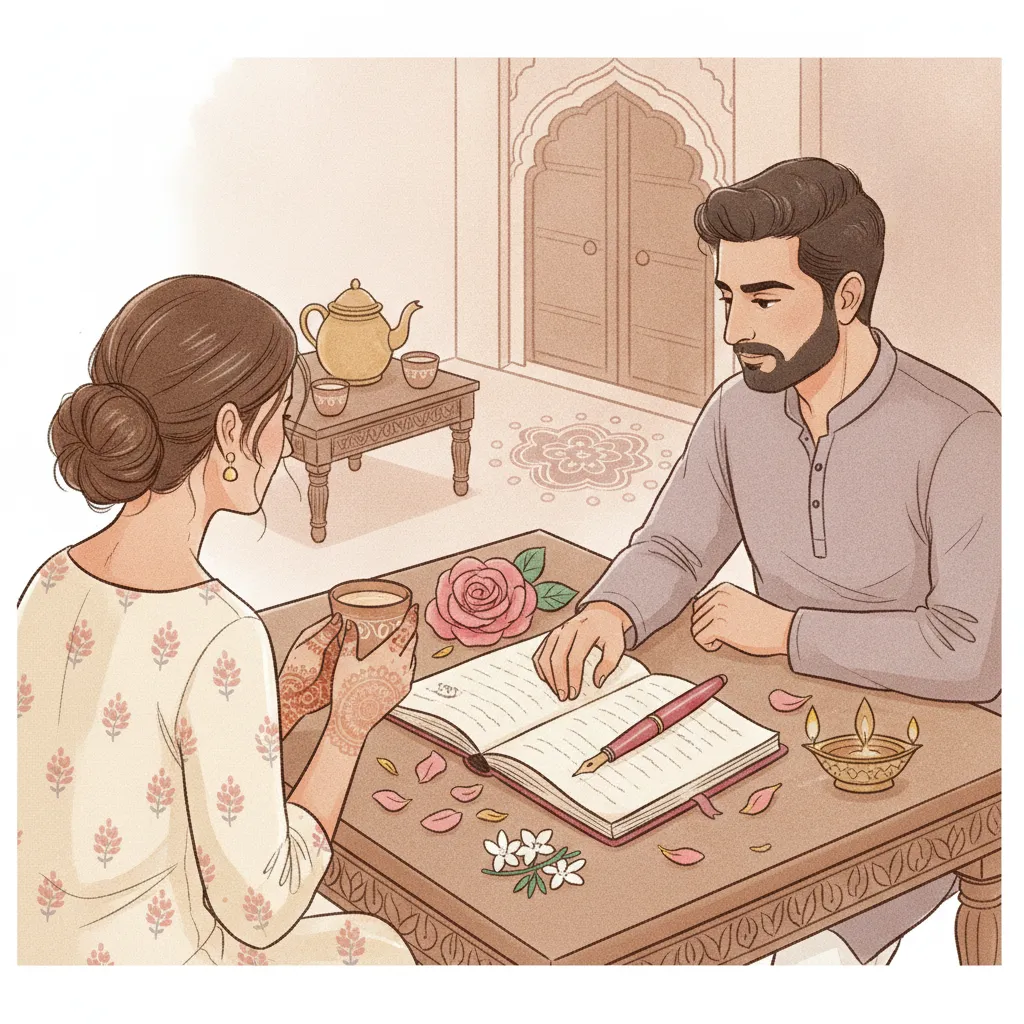
You have scrutinised the bank statements, tallied the assets, and discussed financial goals. You agree on a five-year plan, on how to support your parents, on the kind of life you want to build. This is the due diligence of a modern Indian matrimonial search. It is sensible, necessary, and completely insufficient.
Because there is another budget, one that is never discussed in the formal meetings but which determines the texture of every day you will spend together. This is your emotional budget: the finite, daily capacity you each have for managing stress, offering support, weathering disappointment, and processing change.
A mismatch in your financial planning can be negotiated. A fundamental incompatibility in your emotional budgets is a silent crisis that can bankrupt a marriage over years. The crucial question it forces you to ask, again and again, is this: Am I spending more energy managing the problem, or managing their reaction to the problem? The answer reveals the true nature of your shared emotional economy. After reading this, you will be able to map your own budget and observe a partner's spending habits, giving you a far more accurate forecast of your life together than any payslip could.
The Invisible Ledger of Daily Life
Think of your emotional energy like a bank account. Every morning, you wake up with a certain amount of capital. Some people start the day with a large reserve; others operate on a tighter margin. Every interaction is a transaction. A frustrating meeting at work is a debit. A kind word from a friend is a credit. A major conflict is a massive withdrawal.
This isn't a metaphor; it’s the lived reality of your nervous system. Your ability to be patient, generous, and resilient is a resource, and it is not infinite. Understanding this ledger is the first step.
Anjali, a 42-year-old architect in Indore, is re-entering the matrimonial process after being widowed for five years. She is raising a teenage son and managing her own firm. Her emotional budget is meticulously managed because she knows its limits. "In my twenties," she says, "I had endless energy for long, dramatic conversations. I could stay up all night dissecting a problem. Now? I have maybe ninety good minutes of problem-solving energy a day, and most of it has to go to my son and my clients. A partner who needs to endlessly process every small anxiety, who treats every personal frustration as a five-alarm fire, would leave me emotionally bankrupt by dinner. I am not looking for someone problem-free; I am looking for someone who knows how to self-soothe."
Anjali’s clarity comes from experience, but you do not have to wait for a crisis to understand your own books. Your search for a partner requires you to first become an honest accountant of yourself.
Reading Your Own Balance Sheet
Before you can assess a partner, you must understand your own patterns. There is no right or wrong way to be, only a reality to be acknowledged. The critical insight isn't about slapping a label on yourself, but about understanding the long-term cost of certain dynamics.
What happens when a person who needs quiet solitude to recharge marries someone who needs to talk through every detail to find clarity? At first, it's a small friction. He experiences her need for silence as a rejection; she experiences his need to talk as an intrusion. But over years, this mismatch becomes a compounding emotional debt. Every time a crisis hits, she "borrows" from her own finite reserves to absorb his need to process out loud, leaving her with less for the next day. He, feeling unheard, believes his own emotional account is being ignored. Over five years, she is in a state of perpetual, low-grade burnout she can't explain. He feels chronically unloved and shut out. This is the hidden tax of incompatibility: not a lack of love, but an operational mismatch that creates a permanent deficit for both.
This is also where we see the concept of 'emotional income'. What does a partner who is a net creditor look like in action? They notice your reserves are low without being told. They are the partner who sees you come home from a terrible day and, instead of immediately demanding to know "What happened?", says, "You look shattered. Go lie down for half an hour, I'll make you some tea." That's not just support; it's a deposit. They are actively replenishing your energy, adding to your emotional capital instead of only ever drawing from it.
Observing Their Spending Habits
Once you have a clear picture of your own budget, you can begin to observe theirs. This is not about judgment. It is about compatibility. You are looking for the story their behaviour tells about their emotional economy.
The Pattern of Emotional Overdraft
This is the person whose emotional needs consistently take up all the oxygen in the relationship. Every personal setback of theirs becomes a shared emergency, while your challenges are met with distraction or impatience.
Consider Riya, a 29-year-old schoolteacher in Patna, meeting Sameer, a 31-year-old preparing for his third attempt at the civil services exam. He is intelligent, charming, and under immense pressure. In their first month of conversations, Riya notices a pattern. Whenever he has a bad day—a poor mock test result, a difficult topic—he calls her, distraught, for hours. He needs her to listen, to reassure him, to help him re-make his study schedule. Riya, who is naturally nurturing, is happy to help.
But she starts a mental rupee ledger. The Tuesday night call to calm him down costs her the one hour she had to prepare for her own class observation. The Sunday he needs her to come over immediately because he’s "in a spiral" costs her a ₹1200 train ticket and the family lunch she had promised her aunt. Over six weeks, his emotional emergencies have cost her approximately ₹2500 in direct expenses and, more significantly, about twenty hours of her own personal time. Her own stressful week, involving a difficult parent-teacher meeting, was summarised in five minutes before he turned the conversation back to his syllabus.
Riya sees the mechanism clearly: Sameer consistently centers his own emotional distress, requiring her to manage it. This move, repeated over time, has the effect of establishing a dynamic where he is the permanent patient and she is the permanent caregiver. The relationship subtly becomes about managing his emotional state. Each frantic call is a probe, a test of her boundaries, and by always complying, Riya has taught Sameer that his anxiety is a valid reason to override her schedule, her budget, and her own needs.
This is where Riya must distinguish between a bad season and a bad system. Sameer's stress is real; preparing for the civil services exam, with the weight of his family’s expectations from their small town in Bihar, is a monumental pressure. A temporary emotional deficit during a period like this is normal. A supportive partner leans on the other. But the pattern becomes a permanent overdraft when it’s consistently one-directional. The calibration lies in his awareness. A partner in a temporary deficit might say, "Thank you so much for listening last night. I know I was a mess and you had your own things to do. Tell me how your week is going." He acknowledges the withdrawal he just made. The one with a structural deficit never acknowledges the cost, because he feels entitled to the funds.
The counter-move for Riya is not unkindness, but clarity. The next time he calls in a panic, she can say, with warmth, "It sounds like you’ve had a really hard day and I want to hear about it. I have to finish marking these papers right now. Can I call you back at 9 PM when I can give you my full attention?" His response to this gentle boundary is critical data. Does he accept it, or does he escalate his distress, subtly punishing her for not dropping everything?
This scene shows a man draining a woman’s reserves; reverse the roles and the mechanism of the emotional debt remains identical. It is a dynamic of consumption, not gender.
The Silence That Isn't Peace
Some partners react to stress not with an outburst, but with a dense, brittle silence that is just as costly. They insist everything is "fine" while radiating a tension that curdles the air. They provide no information, leaving you to guess at the source of their moods.
Ajay, a 34-year-old running his family's electronics shop in Jodhpur, is talking to Priya, a 38-year-old ER nurse. He's drawn to her competence and calm. But he notices that after a difficult shift, she goes silent. Not a peaceful, companionable silence, but a tense one. His gentle questions—"Tough day?" "Anything you want to talk about?"—are met with a clipped, "I'm fine, just tired." The atmosphere in the room, however, says something is very wrong.
This withdrawal is the core move. By denying that anything is wrong while non-verbally signalling profound upset, it has the effect of forcing a partner to become a detective. This creates constant anxiety and prevents small issues from being resolved, allowing them to build into major resentments. It makes genuine vulnerability: the essential marriage skill for lasting love impossible. This is often not a strategic probe but a deeply ingrained defence mechanism; they may have learned that expressing needs leads to punishment. They are testing to see if you will respect their wall, or try to breach it.
Pushing for information will only make them retreat further. The counter-move is to respect the boundary while naming the reality: "Okay, I hear you that you're fine. You seem to be carrying a lot from the day, though. I'm here if you decide you want to talk about it." This validates their right to silence but also acknowledges the tension you feel, preventing you from feeling like you're imagining things. Everyone needs time to decompress; the difference is in the communication. A healthy version is, "I had a brutal day. I don't have the words for it yet. Can we just have a quiet dinner?" The pattern that erodes a relationship—what you might call emotional hoarding—is the persistent denial that there is anything to talk about at all, often followed by a sudden explosion of resentment weeks later over the very issue they refused to discuss.
Let's run the tape forward on this silence. In month six of the marriage, it's confusing and frustrating. By year three, it has become a cold war after every disagreement, with days of tense silence you are expected to break. By year seven, you no longer ask what's wrong. You are living with a stranger, navigating their moods like uncharted minefields.
Your First Real-World Stress Test
You will not need to manufacture a crisis. Life, even during the courtship period, will provide one. A flight is cancelled. A parent falls ill. A project at work goes sideways. These are not inconveniences; they are invaluable data points. When a plan is disrupted, watch closely. This is your chance to apply the diagnostic question we started with: Am I spending more energy managing the problem, or managing their reaction to the problem?
Do they fixate on blame ("Who booked these tickets? This is your fault!") or on the problem ("Okay, let's check the next flight on our phones")? The answer to that central question tells you what your life will be like. A partner whose reaction consistently becomes a bigger problem than the problem itself is operating with a permanent and severe emotional deficit.
The Shared Economy You Choose to Build
The goal is not to find someone with a "perfect" or "unlimited" emotional budget. That person does not exist. The goal is to find a compatible economy. Two high-capacity people might build a life of incredible resilience. Two people on tighter budgets might build a quiet, predictable life designed to conserve their energy. A high-need processor can have a wonderful marriage with a high-capacity listener.
The trouble arises from unspoken mismatches. The avoider who marries the processor, the overdrafter who marries someone already in deficit—these are the pairings that grind people down. The problem isn't the individual styles; it's the friction of their incompatibility, day after day. In financial terms, you cannot build a healthy joint account when one person’s spending habits consistently force the other into debt to cover the overdraft. It is not the fault of either person's individual account; it is a failure of the shared system.
This isn't about finding flaws. It is about seeing systems. And once you see the system, you can choose one that is sustainable for the life you actually want to live, not the one you feel you ought to be able to handle. When you find someone whose way of managing life's debits and credits feels like a relief, pay attention. That feeling is what true compatibility feels like. It is the quiet confidence that when a storm comes, the person next to you is a shelter, not another storm you have to manage.
The Budget They Are Trying to Balance With You
Now, turn this lens around. The person you are meeting is performing the exact same assessment of you, whether they have the words for it or not.
When you have a bad day, do you present them with a manageable problem or an emotional black hole? Are you an investment that promises future returns of joy and stability, or a liability that will constantly demand bailouts? They are also observing your spending habits. They are noticing if you have the capacity to listen, or if you are only waiting for your turn to speak. They are gauging if you can handle bad news without crumbling, if you can offer support without making it about you.
They are trying to figure out if your emotional budget is compatible with theirs. They are looking for a partner with whom they can build a sustainable, life-giving economy. The most compelling thing you can bring to the table is not a flawless balance sheet, but the self-awareness to know your own limits and the generosity to respect theirs.