Imagine a couple, five years married, hosting their friends for dinner. Midway through a story, the husband pauses, looks at his wife, and they both break into a quiet, knowing smile. The story isn't the point. The smile is. It’s a silent conversation that flashes back to a disastrous attempt to cook biryani in their first month of marriage, an inside joke so deeply embedded it’s now part of their private language. They navigate the evening as a seamless team, anticipating each other’s needs, their movements a dance of practiced ease. Their friends see a happy couple; they experience a shared world built intentionally, one small moment at a time.
This is not the result of luck. This is the result of design.
Most advice about the first year of marriage reads like a survival guide, a list of conflicts to anticipate and disasters to avoid. It frames this crucial period as a minefield. We at TrueSoulMatch believe that’s a profound mistake.
Your first year isn’t a test to be endured; it’s the blueprint you design for the rest of your life together. The small, deliberate rituals you establish in these first 12 months are not just romantic gestures. They are the load-bearing walls of a thirty-year partnership. The way you learn to talk, to decide, to celebrate, and to solve problems now creates the muscle memory for your future. This is where forever takes shape.
This is your map of what goes right.
The Architecture of "Us": 5 Practices to Build Your Foundation
A strong marriage is a collection of strong habits. In the whirlwind of post-wedding events, family obligations, and settling into a new routine, it’s easy to let the days just happen to you. The most connected couples build their life on purpose. They install rituals that create protected space for their partnership to breathe and grow.
Here are five generative practices to begin in your first year.
The Weekly "State of the Union"
This isn’t a meeting to solve problems; it's a dedicated time to prevent them. Set aside 30 minutes every week—perhaps Sunday evening as you plan for the week ahead—to check in. The goal is gentle alignment.
The rules are simple: no phones, no interruptions. You each get uninterrupted time to answer a few core questions: What felt good this week in our partnership? What felt challenging or distant? Is there anything you need from me in the coming week?
Imagine a 30-year-old software engineer in Hyderabad, newly married to a 28-year-old marketing manager. The first few months are a blur of dinners with extended family. He’s an introvert and is feeling drained, but doesn't want to seem ungrateful. She’s an extrovert and sees these events as fun. A silent resentment could easily build. But during their Sunday check-in, he says, “I loved seeing your cousins, but I realised three big family events in one week leaves me with no energy. For the coming week, could we protect two evenings just for us?” It’s no longer an accusation; it’s a shared logistical puzzle to solve together. This practice turns unspoken anxieties into collaborative plans.
The Anchor Ritual: Your Sunday Breakfast
Life gets busy. Work deadlines, family demands, and social commitments will always try to pull you in different directions. An anchor ritual is a recurring, non-negotiable appointment with each other that holds you steady.
For many couples, a Sunday breakfast works beautifully. It could be as simple as making poha and masala chai together at home, with a strict "no phones at the table" rule. It’s not about the food; it’s about the consistency. It’s the one time in the week you know you will have unhurried, focused time together.
Years from now, the smell of ginger in chai won't just be a smell; it will be the scent of your sacred time. When you go through a difficult season—a stressful project at work, a family illness—this small ritual becomes a vital source of stability and connection. It’s a silent promise that no matter how chaotic life gets, "us" time is protected.
The Small Moments Archive
The grand gestures are memorable, but a marriage is built on the texture of a thousand small, ordinary moments. The first year is dense with them. Create a system to capture them before they fade.
This could be a physical journal where you each write down a small, happy memory once a week. Or it could be a private, shared photo album on your phones. What do you capture? The ticket stubs from the first movie you saw as a married couple. A photo of the ridiculously misshapen roti one of you made. A screenshot of a funny text message. The name of the restaurant where you had a wonderful, unexpected dinner.
This isn't for social media. It's for you. On a tough day five years from now, scrolling through this archive will be a powerful reminder of the joy, laughter, and affection that forms the bedrock of your relationship. You are building your own private, shared history, one small entry at a time.
The Anniversary Letter Exchange
On your first anniversary, start a tradition that will become one of your most treasured possessions. Separately, write a letter to each other, to be exchanged and read on that day.
In this letter, reflect on the year that has passed. What did you learn about your partner? What new thing did you come to love about them? What was a moment you felt incredibly proud of them, or deeply connected to them? What is your biggest hope for them, and for the two of you, in the year to come?
Keep these letters in a special box. Imagine, on your tenth anniversary, sitting down together and re-reading the hopes, dreams, and observations you had as newlyweds. It’s a time capsule of your love, documenting your evolution not just as individuals, but as a unit. It’s a powerful way to honour the journey and to consciously mark the passage of your shared life.
Forging Your Own Traditions
In the Indian context, marriage is often a joining of two families, two sets of traditions, and two sets of expectations. It’s easy for a new couple to feel pulled between "his family's way" and "her family's way," especially during festivals.
The strongest couples intentionally create a "our way."
This isn't about rejecting your families; it's about adding a new, unique layer that belongs only to you. For your first Diwali as a married couple, decide what your tradition will be. Perhaps you honour both families by making one signature sweet from each side. But then, you add something that is purely yours: maybe you buy one new board game to play together every Diwali night, or you start a ritual of donating to a specific charity.
This act of creation is incredibly powerful. It sends a message to yourselves and to the world that you are not just two individuals appended to existing families. You are the foundation of a new one.
The Unsung Victories: Joys to Celebrate on Purpose
The first year is full of quiet, profound milestones that often pass by unacknowledged. Learning to spot and celebrate these small victories strengthens your identity as a team.
The First Major "We" Decision
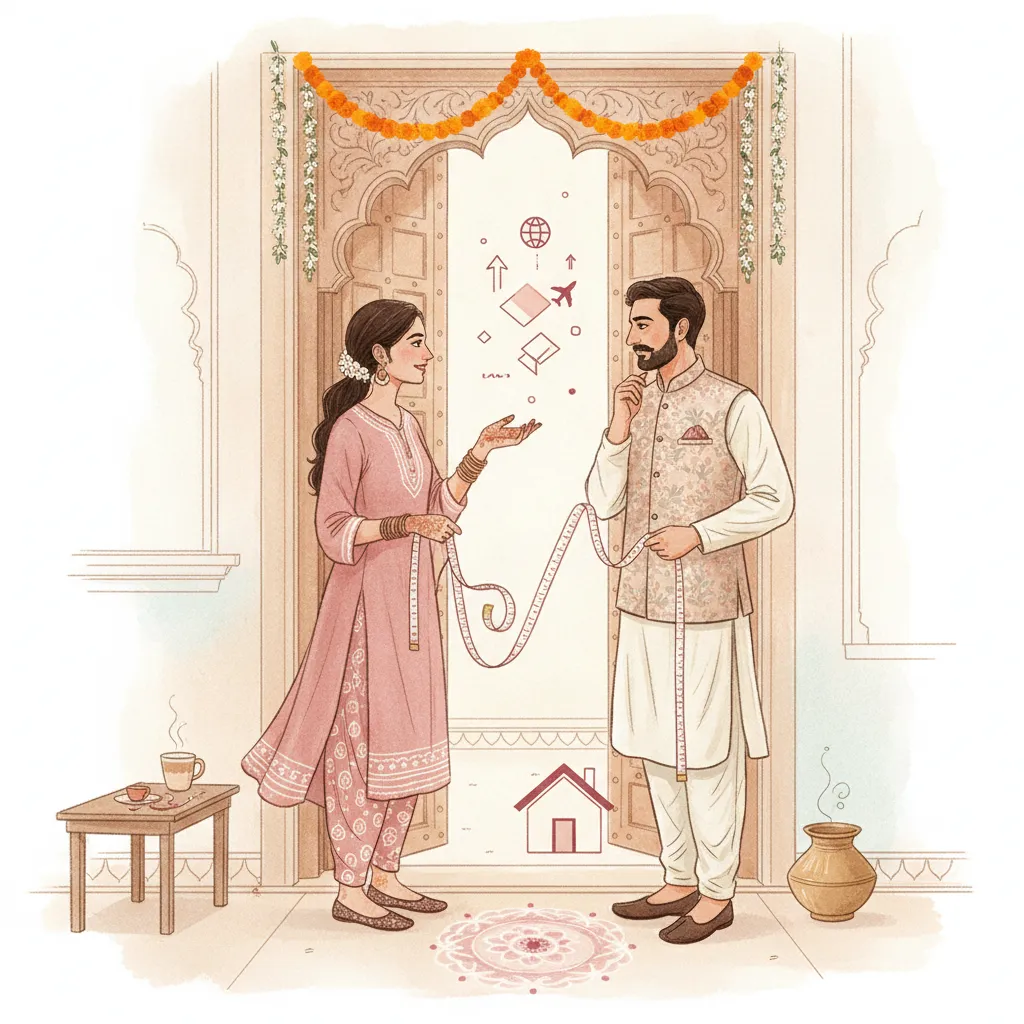
This might be choosing a new sofa, planning your first holiday, or deciding on a major appliance. On the surface, it’s a logistical task. Underneath, it's a complex negotiation of tastes, priorities, and finances.
A couple in Pune, a 29-year-old architect and a 27-year-old teacher, need to buy a car. He is focused on engine performance and resale value. She is focused on safety ratings and boot space for future family needs. Their budget is ₹8 lakhs. The conversations that follow—about what they each value, where they are willing to compromise, how they pool their financial knowledge—are far more important than the car they end up buying. The moment they drive it home, it isn't just a car. It's a trophy of their first successful, large-scale collaboration. Celebrate that moment. Acknowledge it explicitly: "We did a great job with this. We're a good team."
The First Crisis Handled as a Team
It won't be a major drama. It will be small. A cancelled flight that leaves you stranded. A sudden fever the night before a big presentation. A minor leak in the kitchen that floods the floor.
The moment of magic is the pivot from panic or blame to a shared "Okay, what do we do?" One of you starts calling the airline while the other books a hotel. One of you runs to the chemist while the other makes soup. You work in concert, a two-person emergency response team. Afterwards, once the dust has settled, recognise what just happened. That feeling of "we've got this, together" is a foundational experience. It builds a deep-seated trust that you can rely on each other when things get tough.
The First Time You're Seen as a Unit
In the initial months, especially in an arranged marriage context, family members may still relate to you as separate individuals. They'll ask the son about finances and the daughter-in-law about the home.
Then, one day, a shift happens. An uncle, instead of just asking his nephew for advice on an investment, turns to both of you and asks, "What do the two of you think?" Or an aunt, planning a family function, calls you both to ask about your joint availability.
This is a subtle but profound rite of passage. It's the moment your extended family's perception catches up to your new reality: you are a single entity, a partnership. It's a sign of respect and integration. Notice it, and share a quiet, proud smile about it later. You've officially arrived as "Them."
The Birth of an Inside Joke
It will happen unexpectedly. You'll be at a formal family dinner, and someone will use a phrase that reminds you both of a character from a show you just binge-watched. You'll catch each other's eye across the table, a tiny spark of shared amusement passing between you that no one else can see.
This is the beginning of your private culture, your own secret language. It’s a sign that your shared experiences are beginning to form a world that belongs only to the two of you. These jokes are the shorthand for "I get you," and they are priceless.
Ask Yourself This Week
Don't just read this and file it away. The time to build is now. Sit down together this week, for just 20 minutes, and ask each other these two questions:
- Of all the rituals mentioned—the check-in, the breakfast, the journal—which one feels the most exciting or natural for us to try first? Let's commit to trying just one for the next four weeks.
- Looking back at the last month, what was a small, unsung victory we had as a team that we forgot to celebrate? Let's celebrate it now.
The Compounding Magic of a Deliberate First Year
The most enduring, loving marriages you see—the ones that still crackle with affection after 30 or 40 years—all share a common secret. The partners in them remember their first year vividly. Not as a blur, but as a series of conscious choices and cherished firsts.
They remember the Sunday mornings. They remember the arguments over what colour to paint the wall and the pride they felt when they finally agreed. They can pull out the letters they wrote to each other, the paper now soft with age.
The effort you put into your relationship in year one is like a financial investment with a spectacular rate of return. The rituals you start, the communication habits you form, and the shared history you build don't just add up; they compound. The trust you build handling a small crisis in year one is the trust you will draw on during a major life challenge in year fifteen. The shared language you create now becomes the deep, intuitive understanding that comforts you in year thirty.
Don't let this precious, foundational year simply happen. Build it. Brick by brick, conversation by conversation, ritual by ritual.
The forever you both want begins with the purpose you bring to today.