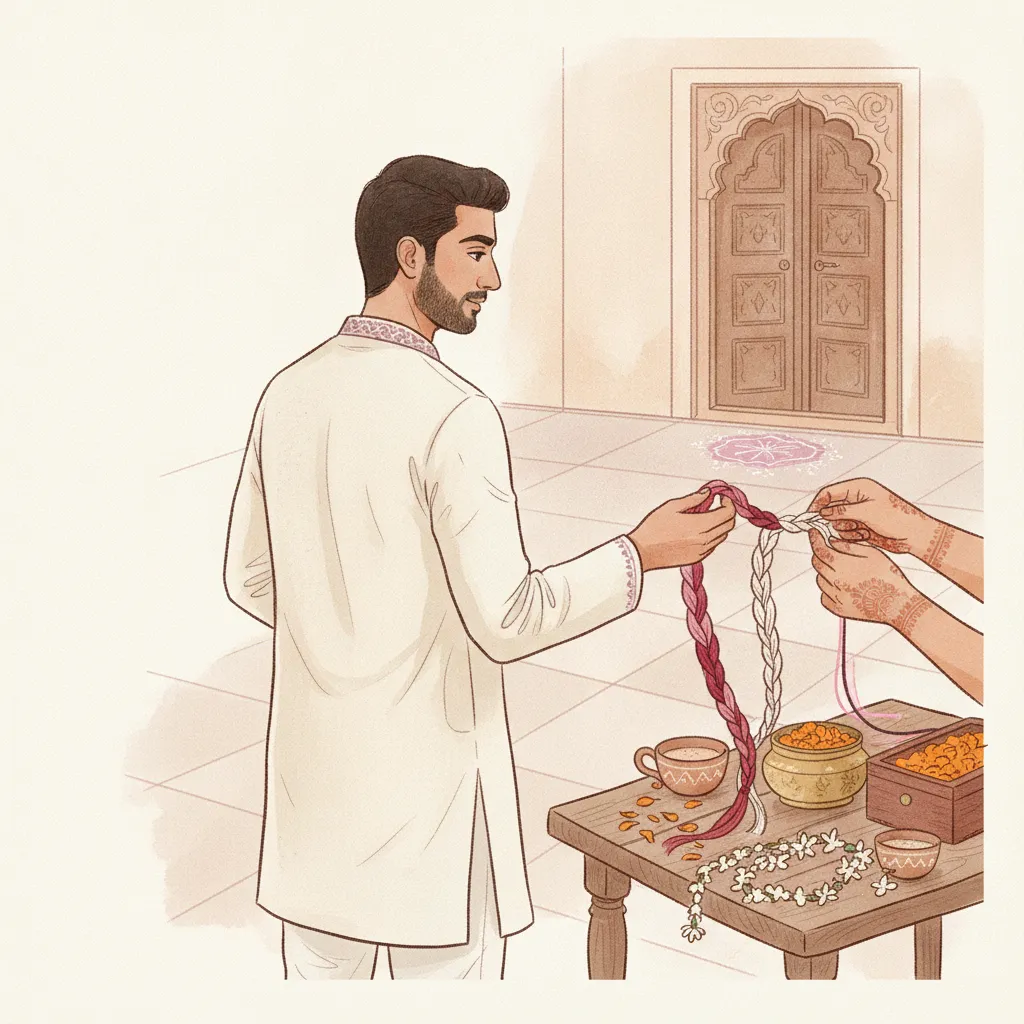
You leave the first meeting with their family feeling relieved. They were warm, they were welcoming, they asked about your work with genuine interest. Your partner’s mother insisted you have more dessert. Their father told a story that made everyone laugh. You felt seen, accepted. You feel like you passed a test.
This is the most common mistake people make. You have answered the question, "Are these nice people?", and the answer is almost always yes. But that is the least predictive data you will ever gather. Hospitality is the baseline for a first meeting, not a special signal.
The question you should be asking is not about warmth. It’s about structure. In this family, in this house you might one day be a part of, who actually decides? Who holds the veto? What is your partner’s real standing in their own home? Because the standing they have now, on the subject of where to order dinner from, is the standing they will have when the subject is you.
The Veto Is Often Silent
Power in a family system rarely announces itself. The person who talks the most, who holds court and tells the best stories, is often not the one with the final say. The real authority is revealed in small, trivial moments when a decision is being made. You need to learn to watch these moments not for their content, but for their mechanics.
Consider Priya, a 27-year-old schoolteacher from Indore, at dinner with her partner, Aman, and his parents for the second time. The conversation is about where to go for a short family trip next month. Aman’s father is enthusiastic, suggesting a resort near Lonavala he’s heard about. He pulls it up on his phone, describes the amenities, and talks for five minutes about how perfect it would be. Aman and Priya are agreeing, it sounds lovely.
Then his mother, who has been listening quietly, says, “It does look nice. A little far for just a weekend, though.” She doesn’t raise her voice. She doesn’t offer an alternative. But watch what happens next. The father’s energy immediately deflates. “Yes, you’re right,” he says, putting his phone away. “Maybe something closer.” Aman nods. The Lonavala plan is dead. It took one sentence from one person to veto the declared preference of the most vocal person in the room.
Priya just learned more in those ten seconds than in the entire hour of pleasant conversation that came before. She learned that in this house, her future mother-in-law’s preference is the silent operating system on which all other applications run. Her father-in-law has the freedom to propose anything, as long as it’s what his wife would have chosen anyway. This isn't good or bad, but it is the map of the territory. When a decision needs to be made about her wedding, or where she and Aman will live, she now knows whose opinion carries the decisive weight.
Your Partner’s Standing Is Your Future Standing
Once you’ve identified who holds the veto, the next question is where your partner sits in relation to it. Do they have a voice, a vote, or just an obligation to agree? The cleanest way to observe this is to see if they can hold a minor, pre-existing boundary with you against a new suggestion from their parents.
This is often a phenomenon best observed with a two-meeting diff: what becomes visible on a second, more casual meeting that was invisible on the first, more formal one.
On your first visit to 30-year-old Kavya’s family home in Jodhpur, everything is perfect. She is attentive, her parents are gracious, and there is a powerful performance of family harmony. Everyone agrees on everything.
The second time you visit, it’s a lazy Sunday afternoon. The formality has dropped. A few days earlier, you and Kavya agreed to go for a long walk around the lake that evening. As you’re having tea with her parents, her mother says, “Oh, Mehra-aunty from next door is coming over with her daughter around seven. We haven’t seen them in ages. Kavya, you’ll be here, of course.”
This is the moment. It’s a trivial conflict of plans. Watch Kavya’s reaction.
Does she glance at you, then at her mother, and say, “Oh. Yes, of course, Maa”? If she does this, she has just demonstrated that any plan made with you is provisional, subject to being overridden without discussion by her parents’ social calendar. She may feel bad about it, she may apologise to you later, but in the moment, her instinct was to fold. Her behaviour shows you that, in her family’s hierarchy, a pre-existing commitment to her partner is less important than a spontaneous request from her mother.
Or does she do this? She meets your eyes for a second, then says to her mother, “Maa, Varun and I were actually planning to go for a walk at the lake this evening. Can we see the Mehras another time? Or maybe we can say hello for fifteen minutes and then leave?”
The difference is everything. She is not being disrespectful. She is holding a boundary. She is demonstrating that her relationship with you has its own integrity, its own plans, and that she sees her role as negotiating the space between her family and her partnership. If she cannot do this for a Sunday evening walk before you are married, she will not be able to do it for a major life decision after. Her standing in that house will become your standing. Every negotiation you think you are having with her will actually be a negotiation you need to have with her parents, because she has already shown you she has no independent position to hold.
The Unspoken Job Description
The call comes, as it always does, in the middle of their third date. "Sorry," Neha says, her smile tightening. "I have to take this. It's my dad." Sameer watches as the entire dynamic of the evening shifts.
Neha, a 28-year-old who helps run her family’s successful textile shop in Patna, had seemed thoughtful and very close to her family, which Sameer initially liked. But he’s starting to see the texture of that closeness. The conversations with her father are frequent, quiet, and intense; he’s upset about something a supplier said, or worried about his health, or anxious about a decision for the shop. Neha spends ten minutes calming him down, promising to handle it. When she hangs up, the easy energy between them is gone. She is distracted, her focus pulled back into her family’s orbit.
Neha’s job is to be her father’s primary emotional regulator. She is the person he turns to with all the feelings he cannot or will not process with his wife. This is a profoundly intimate role. A relationship this enmeshed isn't about love, but about function. Sameer isn't just dating Neha; he's up against the most important job she has. After they marry, her father’s anxiety won’t suddenly be redirected to his wife. It will still come to Neha, and by extension, to their shared life, their shared time, their shared emotional bandwidth. The version of this story where the genders are reversed is just as common, and the mechanism works in precisely the same way.
The problem is not that she loves her father. The problem is that the role she performs for him is the one a person is supposed to grow into with their life partner. If that seat is already taken, you will spend your marriage waiting in the lobby.
A direct question about this is often too confrontational. A better way to see the wiring is to ask a systemic question: “Who does your father usually talk to when he’s really upset with your mother?” or vice-versa. The answer is a blueprint of the family’s emotional machinery. If the answer is “his brother,” or “his best friend,” that’s a sign of a healthy, distributed support system. If the answer is “me, always,” you have just been handed a copy of your partner’s other job description. You need to decide if you want to sign up for a professional life where your partner is permanently on call. For many, the assumption of his parents, the expectation of her care becomes a silent term in the contract.
The Financial Skeleton
Nowhere are family dynamics more brutally clear than in the flow of money. People can be vague about feelings, but bank transfers are specific. Yet this is the one area we are taught it is rude to ask about, especially in the early stages. This is a profound mistake. You are not being intrusive; you are doing the due diligence required before merging your life with someone else’s.
Anjali, a 31-year-old preparing for her third civil services attempt in Guwahati, has been talking to Rohan for two months. He has a good IT job in the same city, earning around ₹1,10,000 a month. He’s charming and seems responsible. But when she asks gentle questions about savings or financial goals, he gets evasive, saying “it’s all handled” or “my father takes care of investments.”
Let’s run the Rupee Ledger that Rohan isn’t sharing. Of his ₹1,10,000 monthly salary, ₹25,000 goes directly via EMI to pay off an unsecured loan his father took to expand the family business two years ago. Another ₹15,000 a month is sent home for his younger sister’s engineering college fees. Another ₹10,000 is his share of his parents’ household expenses. That’s ₹50,000—nearly half his income—that is not discretionary. It is a fixed, non-negotiable family obligation.
From Rohan’s perspective, he is being a good son and brother. He is not trying to be deceptive; this is just the water he swims in. From Anjali’s perspective, this hidden ledger changes everything. It’s not that supporting one’s family is the problem—for many, it’s a source of pride. The destructive element is the lack of transparency. His evasiveness isn’t about protecting his privacy; it’s about presenting a financial reality that doesn’t exist. By obscuring these obligations, he prevents Anjali from being an equal partner in a decision of enormous mutual consequence. He is single on paper, but financially, he is already a core part of a multi-person unit with significant liabilities. This is a classic case where what seems like the line between parental help and financial control has blurred into an unspoken dependency.
You have a right to know the basic financial facts of a person you are considering building a life with. These are not an interrogation, but calm, neutral questions for a shared future.
- “As we think about building a life, it would be helpful to understand our full financial picture. Do you have any ongoing financial commitments to your family, like supporting parents or funding a sibling’s education?”
- “Is there any family property that’s mortgaged, or any major family loans that we would be involved in managing or repaying down the line?”
- “Have you ever been a guarantor for a loan for a friend or family member?”
Evasiveness is the answer. Someone who sees you as a true partner will welcome this conversation as a chance to build a shared foundation. Someone who sees you as an outsider to their primary family unit will treat it as an intrusion.
Two Underrated Sources of Data
There are two people in this ecosystem who are uniquely positioned to tell you the truth.
-
The Existing Daughter-in-Law (or Son-in-Law). If your partner has a married sibling, their spouse is a living, breathing preview of the system you are about to enter. They have already run your experiment. You cannot, of course, ask them “So, are your in-laws difficult?” But you can ask intelligent, open-ended questions in a private moment. The key is to ask about their experience, not their opinion.
- “What was the biggest surprise for you in your first year of marriage here?”
- “Looking back now, what’s one piece of advice you’d give yourself the week before your wedding?”
- “What’s the best thing about being part of this family?” The answers, and what is left unsaid, are pure gold.
-
The Family's Conflict History. A family that insists they “never fight” is either lying or, far more worrisomely, so conflict-avoidant that grievances are buried until they explode. You are not marrying a group of individuals; you are marrying their conflict-resolution culture. Ask about it directly, but gently.
- “Can you tell me about a time the family had a big disagreement and how you all worked through it?” This is not a trick question. A healthy family can talk about a past argument—about a property decision, a wedding plan, a misunderstanding—and describe how they navigated it. They can say who apologised. An unhealthy system will go silent, change the subject, or insist no such disagreement has ever happened. Their inability to recall a single resolved conflict tells you that when conflict inevitably arises with you, they will have no tools to manage it.
The Conversation That Reveals the Blueprint
Understanding the structure you’re entering isn’t about finding a “perfect” family. It’s about seeing the real dynamics so you can make a free and informed choice. Most friction in Indian families comes not from malice, but from unspoken expectations and roles that were never negotiated. Your job is to make them visible.
This doesn't have to be a confrontation. It can start with one question you put to your partner, not as a test, but as a genuine inquiry into how they see their future role. When you are alone, in a quiet moment, ask them this:
“If there were a serious disagreement between your parents and me someday—let’s say about us moving to a different city for a major career opportunity for me—how do you imagine your role in that conversation?”
Now, listen. Don’t listen for the answer you want to hear. Listen for the structure of their thinking.
A concerning answer sounds like deflection or taking a side by default: “Oh, that would never happen,” or “My parents are very reasonable,” or “You’d just have to make them understand.” All of these place the burden of navigation on you, and deny the possibility of a real conflict where loyalties are tested.
A hopeful, constructive answer sounds like they see themselves as a bridge, not a messenger. It sounds like: “Wow, that would be tough. I guess my role would be to hear both sides. I’d have to really understand what you need and why it’s important, and also understand my parents’ concerns. Ultimately, we’d have to make the decision that’s right for us, for our life, and then my job would be to explain that to my parents and manage their reaction. It would be my responsibility to stand with our decision.”
That person is not just choosing you. They are choosing to become part of a new, primary unit. And in the long game of a life together, that is the only decision that truly matters.