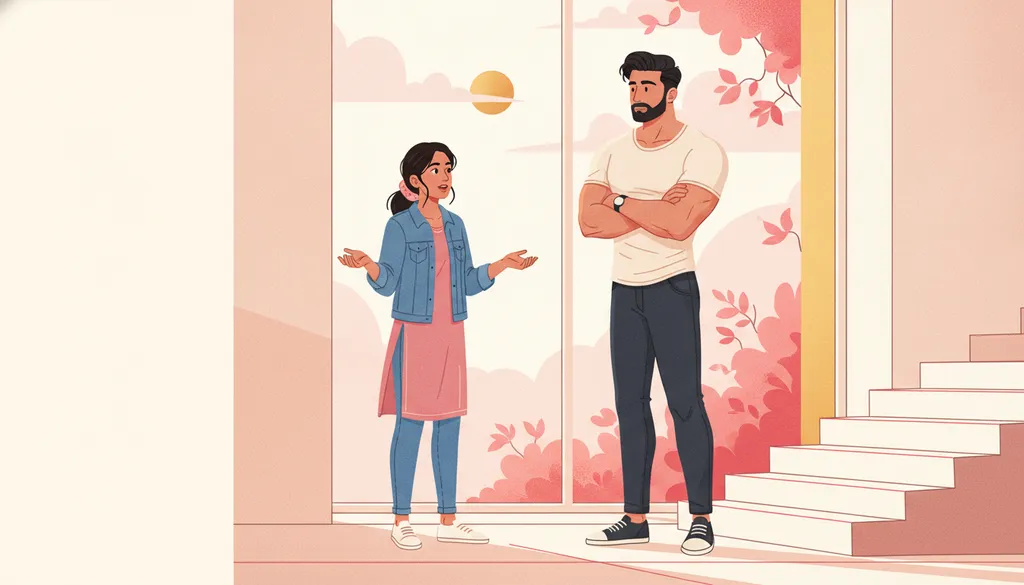
Anjali didn’t mean it to land the way it did. They were at a friend’s place in Indore, a casual Saturday dinner, and someone had asked Rohan again about his UPSC prep. He was on his third attempt, studying full-time while his peers climbed corporate ladders. Anjali, a 23-year-old architect proud of her own career, had tried to deflect with a joke. “He’s practising for a lifetime of service by being a full-time professional husband,” she’d said, laughing. The table laughed with her. Rohan smiled, a tight, thin smile that didn’t reach his eyes.
Later, on the drive home, the silence in the car was heavy. “That thing you said tonight,” he started, his voice flat. “About me being a ‘professional husband.’ That really hurt.”
Your stomach drops. Your first instinct is a defence attorney’s: to argue the case for your intentions. But I was on his side. I was trying to shut them down. Why is he turning on me for trying to protect him? Your brain is already pulling up a file of every supportive thing you’ve ever done, ready to present it as evidence for the defence.
Stop.
The next sentence you say will teach him more about the future of your relationship than the last six months combined. What he’s listening for isn't an explanation of what you meant. He’s listening to see if he is safe to be hurt around you.
The Art of a True Apology
When you’ve hurt someone you love, the impulse to explain why you did it is immense. We do this because the accusation — "You hurt me" — feels like a verdict on our character. We want to prove we are not a hurtful person. But in that moment, your partner is not thinking about your character. They are thinking about their pain. A long, defensive explanation recentres the conversation on you: your intentions, your feelings, your guilt. It subtly asks them to manage your emotions about their pain.
A genuine apology does the opposite. It keeps the focus squarely on them and the impact of your actions. It’s a tool for repair, not a negotiation of guilt. The structure isn't a script to be memorized, but a principle to be understood, focusing on three distinct functions.
First, it demonstrates you were truly listening by being specific. Vague acknowledgements like "I'm sorry for what happened" feel evasive. Saying, "I'm sorry for the joke I made about your career prep," proves you heard exactly what the issue was and are not trying to minimize it. Then, the apology must validate the emotional impact, which is the part most people skip. This is the crucial leap from "I'm sorry I said that" to "I see now how that comment was dismissive and embarrassing for you, especially in front of our friends. I'm sorry I put you in that position." This step isn't about agreeing that you were wrong, or that their feeling is "correct"; it's about confirming that you understand their reality. You are witnessing their pain without judgment. Finally, a complete apology offers a promise of future safety. It answers the unspoken question, "How do I know you won't do this again?" Stating what you'll do differently—"It was a clumsy attempt to be funny and I crossed a line. I'll be more thoughtful about it, and I won't make your career path a punchline again"—rebuilds the trust that was broken.
Then, and this is the hardest part: stop talking.
Let the apology land. Give him space to respond. But what if you do all this, and he's still angry? An apology is an offer of repair, not a transaction that indebts him to forgive you on the spot. If he meets your apology with continued anger or silence, your next move is not to get defensive about your apology ("I said I was sorry, what more do you want?"). It’s to hold steady and respect his feelings. You might say, "I understand you're still upset, and that's okay. I meant what I said, and I'm here when you're ready to talk more." Sometimes, the hurt needs more time to recede than the apology takes to deliver.
The Bid for Repair vs. The Bid for Control
Learning to hear "you hurt me" without defensiveness is the foundational skill for a lasting relationship. It’s what allows small ruptures to be repaired before they become deep cracks. Every time your partner brings you a hurt, they are making a bid for connection. They are saying, "Something is wrong between us; can we fix it?" How you receive that bid determines whether they will risk it again.
Of course, not every bid for repair is as direct as Rohan's. More often, hurt doesn't speak its name; it acts out. It might show up as the punitive silence Kavya encountered on her date, a sudden bout of "strategic incompetence" where he forgets how to do a household task you both normally share, or a passive-aggressive "It's fine" that clearly means the opposite. These are still bids for connection, just expressed through a filter of fear or resentment. The right response isn't to accuse ("Why are you giving me the silent treatment?") but to gently inquire ("I feel some distance between us since this afternoon. Is everything okay?"). This opens the door for the real issue to emerge, teaching you to listen for the feeling behind the behaviour, not just the words being said.
This skill is symmetrical. The expectation is that he can do the same for you. The first time you have to say, "When you check my phone after I get home from a work dinner, it makes me feel like you don't trust me," you are watching for the same capacity in him. Does he hear the impact, or just defend the intent ("I was just curious, it's not a big deal")? His ability to absorb that and say, "You're right. I can see how that feels invasive. It comes from a place of insecurity, but that's my issue to manage, not yours to endure. I'll stop," is the other half of the circuit.
Without this reciprocity, the relationship becomes a one-way street of emotional labour. One person becomes the designated apologiser, the other the designated aggrieved party. And sometimes, that imbalance is not an accident; it's a strategy.
When "Hurt" is a Weapon
There is a difference between a partner who shares a genuine hurt and one who uses the language of hurt to control you. The first is a bid for intimacy; the second is a power play.
Let's look at Priya, a 26-year-old schoolteacher in Jodhpur, and her fiancé, Sameer. Sameer often tells Priya she has "hurt" him. The occasions are oddly specific. She hurts him when she makes plans with her college friends without checking with him first. She hurts him when she has a success at work and talks about it with her family before she tells him. Last month, she "deeply hurt" him by paying her half of a ₹4,000 dinner with another couple, because it made him "look like he couldn't provide."
Here is the exchange that followed the dinner:
Sameer: "I can't believe you did that tonight. Pulling out your card like that." Priya: "I was just paying my share. We agreed we'd split it." Sameer: "It's not about the money. It's about how it looks. You embarrassed me. You made it seem like I can't take care of you. It really, really hurt me." Priya: "I... I'm sorry, I wasn't thinking of it like that." Sameer: "You never are."
By repeatedly framing Priya's autonomy — her friendships, her career success, her financial independence — as a personal injury to him, Sameer accomplishes something insidious. He puts Priya in a constant state of apology for perfectly normal, healthy behaviour, effectively teaching her that her growth comes at the cost of his happiness. This dynamic, it must be said, is not about gender; reverse the roles in this scene and the mechanism of control is precisely the same. It isolates her by making her social and professional life a source of conflict in her primary relationship. Sameer is probing her boundaries. Each time she apologises and yields, she teaches him that his "hurt" is a powerful tool for shaping her behaviour. When a partner’s “hurt” is consistently triggered by your independence, it is not a bid for connection. It is a bid for compliance. A relationship cannot survive on a foundation where one person's growth is seen as a threat to the other. It's the unspoken trade of your 'good life' for theirs.
The innocent version of this looks entirely different. A partner with healthy attachment might say, "I felt a little left out when I heard about your promotion from your brother, I was so excited to celebrate with you!" The focus is on his desire to share her joy, not on her supposed wrongdoing. He is asking to be let in, not for her to become smaller. The pattern to watch for is not a single instance, but a recurring theme: does their pain consistently serve to limit your world?
The Reciprocity You’re Listening For
Your ability to apologize well is only one half of the equation. The other, more critical half is your partner's. You will make mistakes. So will he. The long-term success of your relationship depends less on avoiding conflict and more on your joint ability to repair it.
This is something you can observe, not just hope for. Think about the last two times you had a minor disagreement.
Consider Kavya, a 24-year-old from Nashik meeting a potential match. On their first meeting, he was charming and agreed with everything she said. It felt like perfect chemistry. On their second meeting, she mentioned she wasn’t a fan of a movie he loved. The shift was immediate. He didn't argue, but he went quiet, offered one-word answers, and ended the evening early. Perhaps he was just tired, shy, or having a bad day. A single instance is just data, not a diagnosis. But if a pattern emerges over the next several dates—if he consistently withdraws, grows cold, or subtly punishes you for any minor disagreement—then you have your answer. He isn't looking for a partner; he's looking for a mirror.
What you're listening for is the capacity for self-reflection. Can he see his part in a disagreement? When you bring a hurt to him, does he meet you with curiosity or with a cross-examination? A partner who can say, "Tell me more about how that felt," is a partner you can build a life with. A partner whose first response is always, "That's not what I meant," or, "Here's why you're wrong to feel that way," is telling you that their comfort is more important than your reality. That is a dynamic that will exhaust you over a lifetime, turning you into a one-person support system for their ego. A relationship with a future is one where both people are willing to be the student, to learn what it's like to be on the other side of their own behaviour.
The Repair That Rewrites the Past
Back in the car in Indore, the silence is humming with tension. Anjali takes a breath, pushing past the burning need to defend herself. She turns to Rohan.
“I’m sorry for the joke I made about you being a ‘professional husband’,” she says, her voice quiet but clear.
He stays silent, looking out the window.
She continues. “I can see how that was dismissive of how hard you’re working, and how embarrassing it was to say in front of everyone. It was a stupid thing to say, and I'm sorry I hurt you."
She says the last part, and then she stops. She doesn't fill the silence. She waits.
After a long moment, he turns back from the window. He lets out a slow breath. “Thank you for saying that,” he says. “It just… it felt like you think what I’m doing is a joke.”
“I don’t,” she says, and this time it lands, because it’s not a defence but a reassurance offered after the apology has been made. “I’m proud of you. I just used a clumsy, stupid shortcut to try and shut down the questions. I’ll do better.”
This is not the end of the conversation. They will likely talk more about the pressures he feels, the way their friends’ lives are diverging from theirs, and how she can best support him. But the repair has happened. He brought her a hurt, and she met it with care, not a counter-attack. She taught him, in that moment, that he was safe with her. He, in turn, accepted the apology and re-engaged, teaching her that repair was possible. They didn’t erase what happened. They used it to build something stronger. They chose each other again, right there in the quiet of a parked car.